Plan a 14-day Vietnam itinerary from north to south without rushing
Two weeks is enough to experience Vietnam's three main regions, but not enough to visit every famous destination. A comfortable trip means giving worthwhile places enough time and leaving a few others for another visit.
By Da Lat LoversPublished Updated

North-South railway train on a coastal cliff, central Vietnam
Start in Hanoi and finish in Ho Chi Minh City. Use domestic flights for the long journeys from Hanoi to Hue and Da Nang to Ho Chi Minh City, then travel overland between Hue and Hoi An. That gives you a practical 14-day Vietnam itinerary covering the north, central region, and south without changing hotels every night.
How many days do you need in Vietnam?
Fourteen days is a good starting point for a first trip through Vietnam. You can spend time in Hanoi, Ninh Binh, Ha Long Bay, Hue, Hoi An, and Ho Chi Minh City, with the option of a day trip to the Mekong Delta.
Ten days also work, but you will need to remove two or three destinations. Fifteen days allow a little more flexibility. With three weeks or longer, you can start considering places such as Sapa, Ha Giang, Phong Nha, Da Lat, or Nha Trang on the same journey.
| Trip length | Recommended route | Travel pace |
|---|---|---|
| 7 days | One region, or northern and central Vietnam | Relaxed if you stick to one region |
| 10 days | Hanoi - Ha Long Bay - Hoi An - Ho Chi Minh City | Fairly fast |
| 12 days | Hanoi - Ninh Binh or Ha Long Bay - Hue - Hoi An - Ho Chi Minh City | Moderate |
| 14 days | Hanoi - Ninh Binh - Ha Long Bay - Hue - Hoi An - Ho Chi Minh City | Balanced |
| 15 days | The 14-day route with an extra day in Ninh Binh or Hoi An | More comfortable |
| 21 days | Three regions plus two or three additional destinations | More time to explore |
One thing matters more than the number printed on your flight booking: the number of days you can actually spend sightseeing.
Land in Hanoi at 10 pm and leave Ho Chi Minh City at 8 am on the final day, and a 14-day holiday gives you roughly 12 usable sightseeing days. Domestic flights also take longer than their scheduled flight times suggest: you need to reach the airport, check in, collect your luggage, and travel to your next hotel.
Don't divide your holiday into 14 days and try to fit 14 destinations into them. Allow at least one full day in each major city, an overnight stay for destinations that require a long journey, and a relatively light schedule on domestic flight days.
The best 14-day Vietnam itinerary from north to south
This route works for international visitors exploring Vietnam for the first time and Vietnamese travelers who want to cover all three regions. It moves steadily south, avoiding unnecessary backtracking.
Main route: Hanoi - Ninh Binh - Hanoi - Ha Long Bay - Hanoi - Hue - Da Nang - Hoi An - Da Nang - Ho Chi Minh City.
The two returns to Hanoi during the northern section are intentional. Using Hanoi as a base makes your accommodation easier to manage and provides a convenient departure point for the flight to Hue. You could arrange a more complicated overland route, but this version is easier for families and first-time visitors.
Loading map...
- Hoan Kiem Lake: day 1, lake walk and Old Quarter
- Temple of Literature: morning of day 2
- Trang An: day 3, boat trip in Ninh Binh
- Ha Long International Cruise Port: day 4, cruise boarding (confirm your port)
- Hue Imperial City: morning of day 7
- Hue Railway Station: day 8, train to Da Nang
- Da Nang Railway Station: day 8, car on to Hoi An
- Japanese Covered Bridge, Hoi An: day 9, Ancient Town
- Independence Palace: morning of day 12
- War Remnants Museum: afternoon of day 12
14-day Vietnam itinerary at a glance
| Day | Destination | Main activities | Overnight |
|---|---|---|---|
| 1 | Hanoi | Arrival, Hoan Kiem Lake, Old Quarter | Hanoi |
| 2 | Hanoi | Temple of Literature, Old Quarter, local food | Hanoi |
| 3 | Ninh Binh | Trang An or Tam Coc, Hang Mua | Hanoi |
| 4 | Ha Long Bay | Transfer from Hanoi, overnight cruise | Ha Long Bay cruise |
| 5 | Ha Long Bay - Hanoi | Morning cruise activities, return to Hanoi | Hanoi |
| 6 | Hanoi - Hue | Domestic flight, explore central Hue | Hue |
| 7 | Hue | Imperial City, royal tombs, Perfume River | Hue |
| 8 | Hue - Da Nang - Hoi An | Scenic train or road journey via Hai Van Pass | Hoi An |
| 9 | Hoi An | Ancient Town, countryside, local food | Hoi An |
| 10 | Hoi An | An Bang Beach or Da Nang | Hoi An |
| 11 | Da Nang - Ho Chi Minh City | Domestic flight, central city sightseeing | Ho Chi Minh City |
| 12 | Ho Chi Minh City | Independence Palace, museums, city center | Ho Chi Minh City |
| 13 | Ben Tre or Ho Chi Minh City | Mekong Delta day trip or a relaxed city day | Ho Chi Minh City |
| 14 | Ho Chi Minh City | Breakfast, last-minute shopping, departure | End of trip |
This itinerary includes 13 nights: four in Hanoi, one aboard a Ha Long Bay cruise, two in Hue, three in Hoi An, and three in Ho Chi Minh City. That means four main hotel bases and one overnight cruise, a manageable number of accommodation changes for a two-week trip.
Days 1-2: start in Hanoi and give yourself time to settle in
Spend your arrival day checking in, eating, and getting familiar with the city. Hotels around Hoan Kiem Lake, the Old Quarter, and Trang Tien are convenient if you enjoy walking. From these areas, you can reach the lake, Hang Dao Street, Hang Ngang Street, Hang Bac Street, and the area around St. Joseph's Cathedral without arranging a private car.

For an arrival before 2 pm, an afternoon walk around the lake followed by dinner is enough. After a long international flight, the same day is no time for an out-of-town excursion.
Use your second day for Hanoi's main attractions. In the morning, visit the Temple of Literature, then return toward the center for lunch. In the afternoon, choose another attraction, such as the Vietnam Museum of Ethnology, or spend more time exploring the Old Quarter. The museum is not particularly close to the Old Quarter, so squeezing both into a single morning makes for a rushed visit.
For food, you could try pho at Pho Bat Dan on Bat Dan Street or bun cha at Bun Cha Huong Lien on Le Van Huu Street. There is little benefit in crossing the city to visit several famous restaurants in one day, since travel time and queues can easily take up a good part of your afternoon.
Travelers who already know Hanoi can shorten this section to one day. Put the extra time into Hoi An or Ninh Binh before thinking about another city.
Day 3: take a day trip to Ninh Binh
Ninh Binh is approximately two hours from Hanoi under favorable traffic conditions, close enough for a day trip that covers the area's main landscapes. Leave Hanoi around 7 am so you can begin sightseeing in the morning.
A practical schedule looks like this:
- 7:00 am
Leave Hanoi
Leave your Hanoi hotel.
- 9:00-9:30 am
Trang An boat trip
Arrive at Trang An and begin your boat trip.
- 12:30 pm
Lunch
Lunch and a short rest.
- 1:30-3:00 pm
Hang Mua
Visit Hang Mua if you have enough energy and the weather is suitable.
- 3:30-4:00 pm
Back to Hanoi
Depart for Hanoi.
- 6:00-7:00 pm
Hotel
Return to your hotel, depending on traffic.
Choose either Trang An or Tam Coc for the boat ride. Both offer limestone mountains, rivers, and rural landscapes, so one is plenty for a single day.

Traveling with older family members or young children, or on a particularly hot day? Skip Hang Mua. The viewpoint involves a steep climb of roughly 500 steps, and reaching the top takes more effort than many visitors expect.
A one-day trip is not enough to comfortably cover Hoa Lu, Bai Dinh, Tam Coc, Trang An, and Hang Mua. Trying to include everything means spending more time in the car and less time enjoying the scenery.
Once you return to Hanoi, have dinner near your hotel and get some rest. The next morning involves another early departure.
Days 4-5: spend two days in Ha Long Bay
Ha Long Bay and Ninh Binh are the two destinations travelers most often struggle to choose between when planning northern Vietnam. Ninh Binh works as a day trip. Ha Long Bay is better suited to a two-day, one-night trip: that is what it takes to sleep on the water, enjoy the scenery in the morning, and take part in activities offered by your cruise.
On day four, transfers from Hanoi commonly leave between 7 am and 9 am, depending on the cruise company and pickup location. The drive takes around 2.5-3.5 hours in reasonable traffic.
Many overnight cruises begin boarding around midday. After lunch, your program may include a cave visit, kayaking, swimming, or time on deck.

The actual stops depend on your cruise route. Not every ship visits the same caves or islands, so check the itinerary supplied by the operator.
On day five, overnight cruises commonly return to port around late morning, and transfers reach Hanoi in the afternoon. Keep the evening free for a meal near your hotel.
Avoid booking a domestic flight immediately after your return from Ha Long Bay. The ship's arrival time and road transfer can be affected by weather, port operations, and traffic.
When should you skip Ha Long Bay?
Ninh Binh may be easier to organize for anyone who dislikes overnight boats or is prone to seasickness, and for trips that fall during a period of severe weather warnings. When authorities suspend cruise operations because of unsafe weather, follow the official instructions rather than trying to find a different boat that will depart.
Days 6-7: fly from Hanoi to Hue
After five days in northern Vietnam, head to the central region. There are direct flights from Hanoi to Hue's Phu Bai International Airport, and the flight takes approximately 1 hour and 15 minutes. However, once you include the journey to Noi Bai Airport, check-in, baggage collection, and the transfer to your Hue hotel, allow roughly half a day.
Choose a morning or midday flight when possible. A late departure may leave you with almost no sightseeing time in Hue.
For accommodation, the area south of the Perfume River around Vo Thi Sau, Chu Van An, and Pham Ngu Lao is convenient, with plenty of restaurants nearby and the riverfront close enough for an evening walk.
On your first afternoon, walk beside the Perfume River, see Truong Tien Bridge, and have dinner. A long circuit of royal tombs straight from the airport is too much; save the main sightseeing for day seven.
Start with the Imperial City in the morning. With only one full sightseeing day in Hue, this should be your priority.
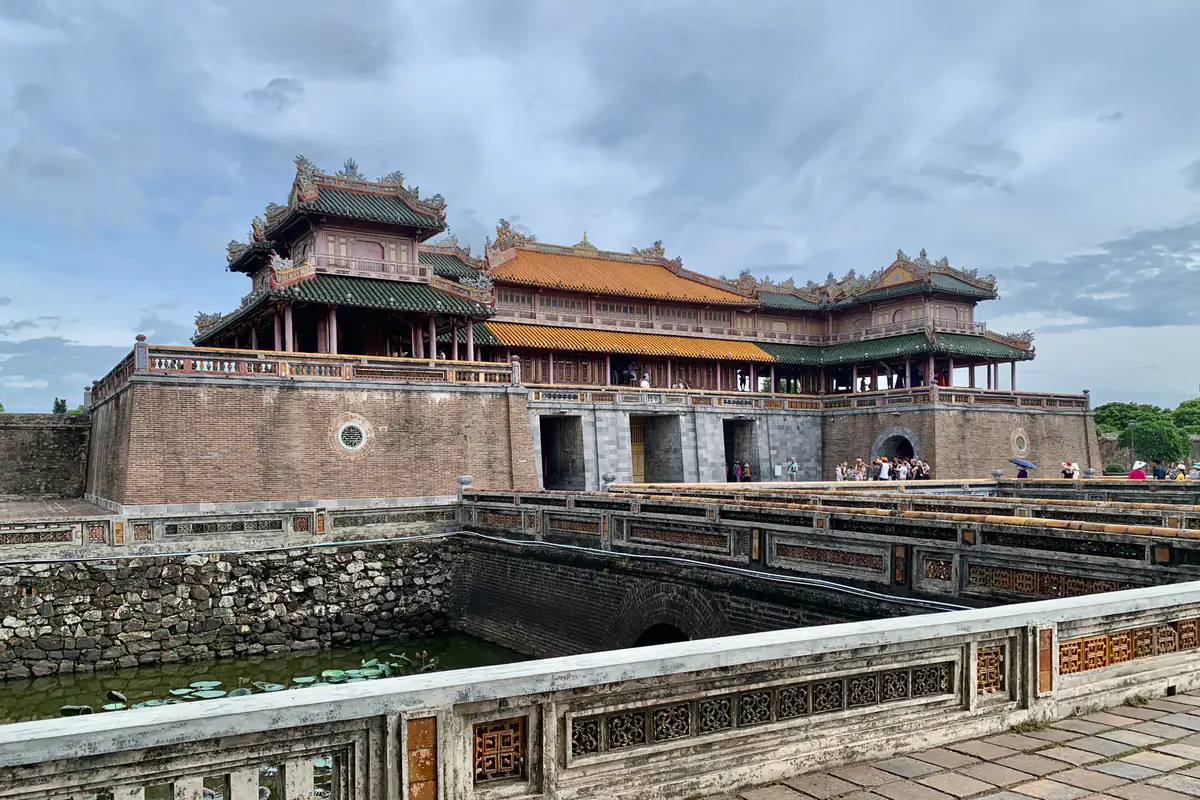
Arriving early helps you avoid some of the midday heat, especially during summer.
In the afternoon, choose one royal tomb, such as Minh Mang Tomb or Khai Dinh Tomb, depending on your interests and transport arrangements. Three tombs in a few hours just to complete a checklist leaves time for little more than a glance at each.
Heavy rain is a good excuse to reduce outdoor sightseeing and spend more time enjoying Hue's food.
Should you skip Hue and fly directly from Hanoi to Da Nang?
Yes, if you have only ten days or are more interested in beaches and Hoi An's old streets than imperial history.
For a 14-day itinerary, however, Hue is worth keeping. Its architecture, history, and atmosphere offer something different from Hanoi and Hoi An. Two nights are sufficient for a first visit, and Phong Nha or Quang Tri can stay out of this section of the journey.
Day 8: travel from Hue to Hoi An via Da Nang
This is one of the overland journeys worth keeping in a Vietnam itinerary. The route between Hue and Da Nang passes the Hai Van mountain area, with views of the coastline and Lang Co.
You have two practical choices.
Option 1: Take the train from Hue to Da Nang.
The Central Heritage Connection tourist train began operating in March 2024. The journey takes approximately three hours and travels through the Hai Van Pass area.
The heritage train has two departures from Hue:
| Train | Departure from Hue | Arrival in Da Nang |
|---|---|---|
| HD1 | 7:05 am | 10:10 am |
| HD3 | 2:30 pm | 6:15 pm |
Schedules can change, so always use the departure and arrival times printed on your ticket.
For this itinerary, the morning train is the better choice. You will arrive in Da Nang before lunch, leaving enough time to travel onward to Hoi An. From Da Nang Railway Station, arrange a car to your hotel in Hoi An; depending on traffic and your exact accommodation, the journey takes around 45-60 minutes.
Option 2: Take a private car from Hue to Hoi An.
A car is easier for families, travelers carrying several suitcases, or anyone who wants to stop near Lang Co along the way. Travel time is around 3-4 hours, excluding long sightseeing stops, and the road tunnel is faster than taking the mountain pass for views.
Combining the train journey, half a day exploring Da Nang, and several additional attractions before reaching Hoi An is too much. This is a transfer day, and it should have some breathing room.
Arrive in Hoi An during the afternoon, check in, and rest. You can walk through the Ancient Town in the evening, but save your main sightseeing for the next day.
Days 9-10: stay in Hoi An for three nights
Hoi An deserves a little more time on this route. The list of major attractions is not endless, but its old streets, countryside, beach, and restaurants are better enjoyed without constantly checking the clock.
Hotels near Cam Pho or just outside the Ancient Town are convenient for evening walks. Cam Chau is a better fit for a quieter neighborhood and easy bicycle rides through smaller roads.
Use day nine for the Ancient Town. Between approximately 7 am and 9 am, the streets are more comfortable for walking, photography, and sightseeing before the busiest periods of the day.

Visit the historic buildings that interest you, explore the streets around the Japanese Covered Bridge, and stop for a drink when you need a break.
Around lunchtime, return to your hotel or find somewhere shaded; in summer, several hours of walking outdoors through the middle of the day can be exhausting. Return to the old town later in the afternoon or evening, walk along the Hoai River, and find somewhere for dinner.
On day ten, choose one of two directions:
- If you prefer the beach: Spend the morning at An Bang Beach and relax in Hoi An afterward.
- If you want to see Da Nang: Visit My Khe Beach or the Han River area, then return to Hoi An.
One is enough for the day. My Son Sanctuary can also take day ten as a half-day or longer excursion, in which case Da Nang or An Bang Beach comes off the schedule.
Should you spend a night in Da Nang?
Usually not. With three nights in Hoi An, you can visit Da Nang without moving hotels. Packing your bags and checking into another hotel for a single night is rarely worthwhile unless it serves a practical purpose.
One exception is an extremely early flight from Da Nang Airport. In that situation, staying closer to the airport the previous night may make sense.
Days 11-12: fly to Ho Chi Minh City
From Hoi An, return to Da Nang International Airport for your flight to Ho Chi Minh City. The nonstop flight takes around 1 hour and 25-30 minutes, but from leaving your Hoi An hotel to checking into your next hotel in Ho Chi Minh City, allow approximately half a day.
A morning or early afternoon flight works well. Avoid a very late flight unless there is a strong reason to choose it.
For accommodation, look around Ben Thanh Market, Ly Tu Trong Street, the Nguyen Thai Binh area, or near Nguyen Hue Walking Street. Check the actual hotel location on a map, since a description such as "central location" can mean a lot of things.
On day eleven, keep things simple: take a walk along Nguyen Hue Walking Street, visit the riverside, and have dinner.
On day twelve, explore the main attractions. Start with the Independence Palace, also known as Reunification Palace. From there, you can continue to other central landmarks without traveling across the entire city.
In the afternoon, history buffs can visit the War Remnants Museum, which covers the country's wartime history. Some exhibitions contain disturbing photographs and historical material, so families with younger children may want to consider whether it is appropriate for them.
Leave the evening free; a full day of city sightseeing is enough without an out-of-town excursion on top.
Ho Chi Minh City gets busy during commuting hours. Staying close to the places you want to visit saves more time than choosing a distant hotel and relying on taxis several times a day.
Day 13: visit Ben Tre or stay in Ho Chi Minh City
Day thirteen is the flexible part of the itinerary.
A day trip to Ben Tre is the easiest way to experience the Mekong Delta. The journey from Ho Chi Minh City to the sightseeing areas around Ben Tre takes around 2-3 hours each way, depending on traffic and your starting point. Leave the city around 7 am. A typical excursion may include a boat ride along the waterways, visits to local workshops, and time in the countryside, with a return to Ho Chi Minh City in the late afternoon or evening.
Don't try to combine Ben Tre with Cai Rang Floating Market on the same day. Cai Rang is in Can Tho, and the market is best experienced early in the morning. It fits much better into a Mekong Delta itinerary that includes an overnight stay.

Already tired after nearly two weeks of travel? Staying in Ho Chi Minh City is also a sensible choice. You could visit the Cu Chi Tunnels on a half-day tour, spend time at a museum, go shopping, or simply have a slower day.
For anyone flying out internationally the following day, sleeping in Ho Chi Minh City on night thirteen also removes the need for a last-minute intercity transfer.
Day 14: finish your trip in Ho Chi Minh City
Leave most of the final day unplanned. An afternoon or evening flight may still leave time for breakfast, coffee, and a little shopping near your hotel.
But don't schedule a distant excursion or plan to return from another province on the same day as your international departure. Allow enough time to reach Tan Son Nhat International Airport, complete check-in, and deal with traffic delays.
Check the terminal shown on your ticket. Domestic and international flights can use different terminals, and terminal assignments can change.
A 10-day Vietnam itinerary: what should you cut?
With only ten days, remove a few destinations completely instead of reducing every stop to a few hours. The simplest route is Hanoi, Ha Long Bay, Hoi An, and Ho Chi Minh City.
Recommended 10-day Vietnam itinerary
| Day | Destination | Main plan |
|---|---|---|
| 1 | Hanoi | Arrival and light sightseeing |
| 2 | Hanoi | Old Quarter and major attractions |
| 3 | Ha Long Bay | Overnight cruise |
| 4 | Ha Long Bay - Hanoi | Return to Hanoi |
| 5 | Hanoi - Da Nang - Hoi An | Fly to Da Nang and transfer to Hoi An |
| 6 | Hoi An | Explore the Ancient Town |
| 7 | Hoi An | An Bang Beach or countryside |
| 8 | Da Nang - Ho Chi Minh City | Fly south |
| 9 | Ho Chi Minh City | Explore the city center |
| 10 | Ho Chi Minh City | Departure |
Compared with the 14-day itinerary, this version removes three stops.
Skip Ninh Binh. Ha Long Bay already gives you a major nature experience in northern Vietnam. The landscapes are different, but including both on a ten-day trip would take time away from central or southern Vietnam.
Skip Hue. Flying directly from Hanoi to Da Nang removes an additional stop and hotel change. You still have Hoi An to experience the architecture, food, and culture of central Vietnam.
Skip the Mekong Delta. A day trip to Ben Tre requires most of a day. Ho Chi Minh City deserves at least one proper sightseeing day of its own.
These places are not being removed because they are less interesting. They simply don't fit comfortably into the available time.
Can you visit Ninh Binh instead of Ha Long Bay?
Yes, and it is the obvious swap for anyone who doesn't want to go on an overnight cruise. Spend day three visiting Ninh Binh and return to Hanoi that evening. On day four, fly from Hanoi to Da Nang, then give the extra time to Hoi An or Ho Chi Minh City.
You will miss the overnight experience on the bay, but you won't have to transfer luggage onto a cruise ship or coordinate your schedule around the ship's return time. For families with young children, travelers prone to seasickness, or anyone mainly interested in limestone landscapes, this is a practical alternative.
On the other hand, when sleeping on Ha Long Bay is one of the experiences you most want from your first Vietnam trip, keep the cruise and skip Ninh Binh.
A 15-day Vietnam itinerary: where should the extra day go?
An additional day is no reason to add another city. Keep the Hanoi - Hue - Hoi An - Ho Chi Minh City route and spend the extra day somewhere already included. Two places work best.
Option 1: spend one night in Ninh Binh
Instead of taking a day trip from Hanoi on day three, stay overnight around Tam Coc or Trang An.
On day three, travel from Hanoi to Ninh Binh, take a boat trip, and check into your accommodation. On day four, use the morning for another attraction, such as Hoa Lu, Tam Coc, or somewhere suited to your interests, then return to Hanoi in the afternoon and spend the night there. On day five, leave for your Ha Long Bay cruise. The rest of the itinerary moves back one day, with departure from Ho Chi Minh City on day fifteen.
This option suits travelers who enjoy rural scenery, cycling, boat trips, and a quieter atmosphere outside the major cities. You gain time to explore Ninh Binh without rushing through several places in one afternoon. The trade-off is one more hotel change.
Option 2: add another day in Hoi An
A fourth night in Hoi An avoids another accommodation change. Use the additional day for Da Nang, My Son Sanctuary, or simply relaxing at An Bang Beach, with no long-distance transfer or new hotel involved. This option works well for couples, families, and travelers who prefer a slower holiday.
Between the two, choose Ninh Binh for landscapes and countryside, and Hoi An for an easier trip with more time to rest.
Hanoi to Da Nang itinerary: do you really need to stop in Hue?
Not every north-to-south Vietnam itinerary needs to include Hue. On a ten-day trip, flying directly from Hanoi to Da Nang is the easier option.
Direct flights take around 1 hour and 15-35 minutes, depending on the service, which connects northern and central Vietnam without spending a whole day traveling overland. From Da Nang Airport, continue to Hoi An and use it as your base for two or three nights.
There are three practical advantages.
First, you eliminate a hotel change in Hue.
Second, there is no transport to arrange between Hue and Da Nang.
Third, you have more time in Hoi An or Ho Chi Minh City.
The trade-off is that you miss Hue's Imperial City, royal tombs, and the scenic railway journey through Hai Van Pass.
Keeping Hue makes sense on a 14-day trip, while ten days call for flying directly from Hanoi to Da Nang.
There is also the option of taking an overnight train from Hanoi to Hue and continuing to Da Nang afterward. That can be rewarding for travelers who want the train itself as part of the experience, but it is not the fastest way to cover the distance.
Should you travel around Vietnam by plane, train, or bus?
Mix your transport rather than using the same form throughout the trip. Some railway journeys are scenic enough to be attractions in themselves. Flights are best for longer distances, while cars and buses are useful for destinations away from major airports and railway stations.
Recommended transport for each route
| Route | Recommended transport | Approximate travel time |
|---|---|---|
| Hanoi - Ninh Binh | Car, bus, or train | 2-2.5 hours |
| Hanoi - Ha Long Bay | Limousine van, car, or cruise transfer | 2.5-3.5 hours |
| Hanoi - Hue | Flight | 1 hour 15 minutes in the air |
| Hanoi - Da Nang | Flight | 1 hour 15-35 minutes in the air |
| Hue - Da Nang | Train or car | Around 3 hours |
| Da Nang - Hoi An | Car, taxi, or shuttle | 45-60 minutes |
| Da Nang - Ho Chi Minh City | Flight | Around 1 hour 30 minutes |
| Ho Chi Minh City - Ben Tre | Car or organized tour | 2-3 hours each way |
These are planning estimates, not guaranteed arrival times. Flight durations do not include airport transfers, check-in, or baggage collection.
When is the North-South train worth taking?
Vietnam's railway is worth experiencing when the journey itself is something you want to enjoy. On a two-week itinerary, the Hue - Da Nang section is one of the easiest scenic journeys to include. Traveling during daylight allows you to see the coastline, mountains, and Lang Co area while still reaching Hoi An on the same day.
The Hanoi - Hue route also has overnight sleeper trains, taking around 12-14 hours depending on the service. You save one hotel night, but sleeping on a train is different from sleeping in a private hotel room.

Light sleepers, or anyone who needs a full night's rest before exploring Hue, may find flying more comfortable.
Traveling the entire distance from Hanoi to Ho Chi Minh City by train can take well over 30 hours, depending on the service. On a 10-14 day holiday, almost two days for one train journey is a poor use of your time, unless traveling the Reunification Railway is one of your main reasons for visiting Vietnam.
Should you use sleeper buses?
Sleeper buses can be useful for medium-distance journeys, particularly for travelers already comfortable with overnight road travel. But taking several night buses in a row can leave you tired and make the following day less enjoyable.

An itinerary that includes an overnight bus from Hanoi to Hue, a full day of sightseeing, and another overnight journey the next evening is not ideal for most people on holiday. Families with young children and visitors unfamiliar with Vietnam's roads may prefer fewer overnight road transfers.
On a two-week itinerary, two domestic flights are reasonable. They allow you to spend more of your holiday at your destinations rather than traveling between them.
Which destinations should you skip on a two-week Vietnam trip?
Vietnam has a long list of places worth visiting, and beauty is rarely what decides it. Ask instead whether a place fits your route and whether you have enough time to enjoy it properly.
Sapa and Ha Giang: save them for a northern Vietnam trip
Both Sapa and Ha Giang deserve time, but neither works well as a rushed overnight addition to a two-week north-to-south itinerary. Sapa is better with two or three days for mountain scenery, village visits, and some time to rest.
Ha Giang deserves several days, particularly for its northern mountain roads. Getting there from Hanoi takes time, and the distances between attractions can be considerable. Adding both would make northern Vietnam dominate the holiday.
Travelers whose main interest is mountains should remove Ha Long Bay or Ninh Binh and dedicate several days to either Sapa or Ha Giang, rather than trying to keep all four.
Phong Nha: don't visit for just a few hours
Phong Nha - Ke Bang is located along the broader north-south travel corridor, but reaching the area and visiting its caves requires time. Adding it from Hue means planning the journey toward Dong Hoi or Phong Nha, allowing time for cave visits, and working out how to reconnect with your main route. A short stop rarely justifies the additional travel.
Phong Nha works better when you have around three weeks in Vietnam or are concentrating on central Vietnam.
Da Lat: beautiful, but away from the main route
Da Lat is not directly on the coastal corridor connecting Da Nang with Ho Chi Minh City. Adding it means arranging transport into the Central Highlands, spending time there, and then continuing south, and one night is not enough to justify that journey.
Da Lat fans should allow at least two nights and remove another destination. On a 14-day itinerary, leaving Da Lat for a separate trip makes more sense than squeezing it between Hoi An and Ho Chi Minh City.
Nha Trang and Mui Ne: add one only if beaches are your priority
Nha Trang and Mui Ne are worthwhile beach destinations, but this route already includes Ha Long Bay and the coast near Hoi An. Another beach stop means more transport, another hotel, and potentially another travel day.
For several days by the sea, transfer some time from Hue or northern Vietnam to one beach destination. Three different beach stops add travel without adding much coastline you haven't already seen.
Phu Quoc: better as a separate island holiday
Phu Quoc requires an additional flight or a combination of road and sea transport, depending on where you start. It works better as a multi-day island holiday than a quick stop on a mainland journey.
Adding it toward the end of your itinerary also means coordinating a return flight to a city with international departures. On a two-week trip, save Phu Quoc for another visit.
What is the best time of year for a north-to-south Vietnam trip?
There isn't one month that guarantees good weather throughout Vietnam. Northern, central, and southern Vietnam have different rainfall patterns, so check the climate before booking hotels and outdoor activities.
February-April: a good period to consider
March and April are good months for a journey combining Hanoi, Hue, Hoi An, and Ho Chi Minh City. Northern Vietnam can be pleasant for walking and sightseeing, central Vietnam moves into a drier period, and southern Vietnam still has plenty of sunny days.
February can also work, although northern Vietnam may be cold and misty. If your dates overlap with Tet, Vietnam's Lunar New Year holiday, allow for changes in business opening hours, transport availability, and demand for accommodation.
May-August: expect heat and some heavy rain
Summer can be good for beach activities in central Vietnam, but Hanoi, Hue, and Hoi An may be very hot. Schedule walking, climbing, and outdoor historic sites for the early morning, and use the hottest part of the day for rest, coffee shops, or indoor attractions. Walking continuously from 10 am until 3 pm simply to finish a list of sights will wear you out.
Northern Vietnam can also experience periods of heavy rain and tropical storms during summer. Anyone with a Ha Long Bay cruise booked should monitor the operator's weather updates and official sailing notices.
September-November: be flexible around Hue and Hoi An
This period deserves particular attention on any itinerary through central Vietnam. Hue and Hoi An have a later rainy season, with heavy rainfall and possible flooding during parts of the autumn months, and Hoi An can still be wet in November.
During this period, prioritize accommodation with reasonable cancellation or date-change conditions, and avoid committing too early to nonrefundable outdoor activities.
Depending on the forecast near your departure date, you may want to reduce time in central Vietnam and spend an extra day in Hanoi, Ninh Binh, or Ho Chi Minh City.
December-January: better conditions in the south, cooler weather in the north
The end of the year is popular with many international travelers. Ho Chi Minh City and much of southern Vietnam enter the drier part of the year. Hanoi and Ha Long Bay, however, can be cold and misty, particularly early in the morning, and central Vietnam can still experience extended rainy periods, especially in early December.
Bring clothing suited to all three regions: a jacket for northern Vietnam, rain protection for the central region, and lighter clothes for the south.
How should international and Vietnamese travelers adjust the itinerary?
Both groups can follow the same basic route, but each will split the time differently.
International visitors traveling to Vietnam for the first time
Keep at least your first two days in Hanoi to get familiar with the pace of the city, the climate, and local transport. After a long international flight, your arrival day is too soon for a Ninh Binh trip or Ha Long Bay cruise.
A north-to-south itinerary is particularly convenient with an international flight into Hanoi and a return flight home from Ho Chi Minh City. When available, compare a multi-city international ticket with a round-trip ticket from the same airport before purchasing.
A flight home from Hanoi means returning north at the end of the journey. Don't schedule a separately ticketed domestic flight from Ho Chi Minh City too close to your international departure. Leave enough time for delays and any necessary terminal changes.
Vietnamese travelers planning a cross-country holiday
Travelers who already know Hanoi or Ho Chi Minh City can shorten their stay in one of those cities. For example, someone living in Hanoi could begin with Ninh Binh or Ha Long Bay, then fly to central Vietnam, putting the saved time toward Hue or Hoi An.
Someone living in Ho Chi Minh City could fly to Hanoi first and gradually work south toward home. Familiar attractions can be dropped, even when they appear in a standard tour itinerary.
Families with children or older travelers
Try to reduce the number of consecutive early starts. A Ninh Binh day trip followed immediately by a Ha Long Bay cruise may feel demanding for some families, who can choose one of the two destinations and spend the remaining day resting in Hanoi.
Prioritize hotels with lifts, convenient locations, clear transfer arrangements, and fewer changes of transport.
Don't calculate journeys using only the fastest advertised travel time. With children or several suitcases, boarding, disembarking, and waiting can take longer.
How to book transport and hotels without disrupting the itinerary
Even a well-designed itinerary can become tiring when transport is booked in the wrong order. Secure the important parts first, then add the smaller activities.
Book your international flights first
Check your arrival date in Hanoi and your departure date from Ho Chi Minh City, paying particular attention to arrival times. A flight that lands near midnight doesn't count as a full sightseeing day.
A round-trip ticket to one city may be significantly cheaper, but calculate the additional cost and time of returning to that city before deciding.
Choose your two domestic flights
For the proposed 14-day route, the main domestic flights are:
- Day 6: Hanoi (HAN) to Hue (HUI).
- Day 11: Da Nang (DAD) to Ho Chi Minh City (SGN).
For the ten-day itinerary without Hue, replace the first flight with Hanoi to Da Nang.
The earliest possible departure is not worth it when it means reaching the airport in the middle of the night. A flight that arrives around late morning or early afternoon is easier to manage. When comparing fares, look at checked baggage, change conditions, and overall journey time.
Reserve your Ha Long Bay cruise before smaller tours
An overnight cruise has specific sailing dates, boarding ports, and operating schedules, which makes it harder to rearrange than an afternoon walking around Hanoi. Check your cruise dates before fixing the flight to Hue.
Once your cruise is booked, keep the overnight stay in Hanoi before flying to central Vietnam. That buffer reduces the risk of a late return from the bay affecting your next flight.
Choose hotels that reduce transfers
In Hanoi, use one hotel as your base for the city portion of the trip, and ask whether it can store your larger luggage during your overnight cruise.
Hue needs just one hotel for both nights. Hoi An is the same: keep one hotel for all three nights unless an early flight gives you a good reason to move closer to Da Nang Airport. And in Ho Chi Minh City, stay at the same hotel until departure, since a day trip to Ben Tre or Cu Chi is no reason to move.
Every hotel change involves packing, checking out, waiting for transport, and checking in again. These tasks can take a surprising amount of time over a two-week holiday.
Leave some free time
A whole day of inactivity is more than you need, but a few afternoons without fixed bookings are useful. The afternoon of day five in Hanoi, day ten in Hoi An, and day thirteen in Ho Chi Minh City provide opportunities to adjust your plans.
When heavy rain disrupts an outdoor activity, you can rest or visit somewhere indoors without reorganizing the entire trip.
Common mistakes when planning a Vietnam itinerary
Mistake 1: Counting destinations instead of usable days. A list of ten cities won't make a holiday more interesting. You may end up seeing little beyond airports, train stations, and hotel rooms.
Mistake 2: Taking long-distance buses everywhere to save money. Overnight buses can be useful when you have plenty of time, but they aren't the right choice for every two-week holiday. Ticket prices matter, but so do your time and energy.
Mistake 3: Booking a flight immediately after an activity with an uncertain finish time. Returning from a Ha Long Bay cruise and heading straight to Noi Bai Airport for an afternoon flight is one example. A delayed return to port or heavy traffic can disrupt your plans.
Mistake 4: Traveling from Hue to Hoi An, then returning to Hue to catch your next flight. On a north-to-south journey, travel from Hue through Da Nang to Hoi An and then fly onward from Da Nang. Retrace the route only for a specific purpose.
Mistake 5: Including too many destinations that fill the same role. Ha Long Bay, Ninh Binh, Sapa, and Ha Giang are all rewarding nature destinations, but each requires time. Choose one or two for your first trip rather than trying to include all four.
Mistake 6: Ignoring regional rainy seasons. A two-week holiday can take you through very different weather conditions. Checking the forecast for Hanoi doesn't tell you what to expect in Hue, Hoi An, or Ho Chi Minh City.
Should you choose a 10, 14, or 15-day Vietnam itinerary?
With two weeks, choose the 14-day route from Hanoi through Ninh Binh, Ha Long Bay, Hue, and Hoi An to Ho Chi Minh City, using two domestic flights and one scenic train or road journey in central Vietnam.
If you only have ten days and are deciding between a packed itinerary with many stops and a simpler route with four main destinations, choose the simpler one. You'll spend less time changing hotels and more time actually experiencing Vietnam.
FAQ
Is 10 days enough to travel from north to south Vietnam?
Yes, ten days are enough to visit all three regions and see several major attractions, but not enough to explore them in depth. Keep Hanoi, Ha Long Bay or Ninh Binh, Hoi An, and Ho Chi Minh City, and fly between the main regions. Avoid adding Hue, Da Lat, Nha Trang, and the Mekong Delta to the same ten-day trip.
How many days do you need in Vietnam?
For one region, five to seven days can be enough to see the main highlights. For a north-to-south Vietnam itinerary, 12-15 days is a practical amount of time. If you want to explore the northern mountains and destinations away from the main route, plan for around three weeks or longer.
Is it better to travel through Vietnam by train or plane?
Trains are worth taking on scenic sections, especially between Hue and Da Nang. For long journeys such as Hanoi to Ho Chi Minh City, flying makes more sense when you only have 10-14 days. Traveling the whole country by train is best treated as a deliberate railway experience rather than the default option.
Should you start a Vietnam itinerary in Hanoi or Ho Chi Minh City?
Either direction works. Starting in Hanoi makes sense if you want to explore northern Vietnam first and gradually move south. If your international flights are more convenient through Ho Chi Minh City, reverse the itinerary. The main goal is to travel in one direction and avoid unnecessary backtracking.
Should you add Da Lat to a 15-day Vietnam itinerary?
Only if Da Lat is one of your highest priorities. It sits away from the main north-to-south route and deserves at least a couple of nights, plus the time needed to reach it. For a 15-day trip, adding an extra day in Hoi An or Ninh Binh is usually a more comfortable option.