Choose the best Hue to Da Nang train for sea views over Hai Van Pass
Take the morning HĐ1 heritage train and choose a left-side window seat if you want the best chance of seeing the coast along Hai Van Pass. The SE3 is a better choice when saving money and arriving sooner matter more than the onboard experience.
By Da Lat LoversPublished Updated
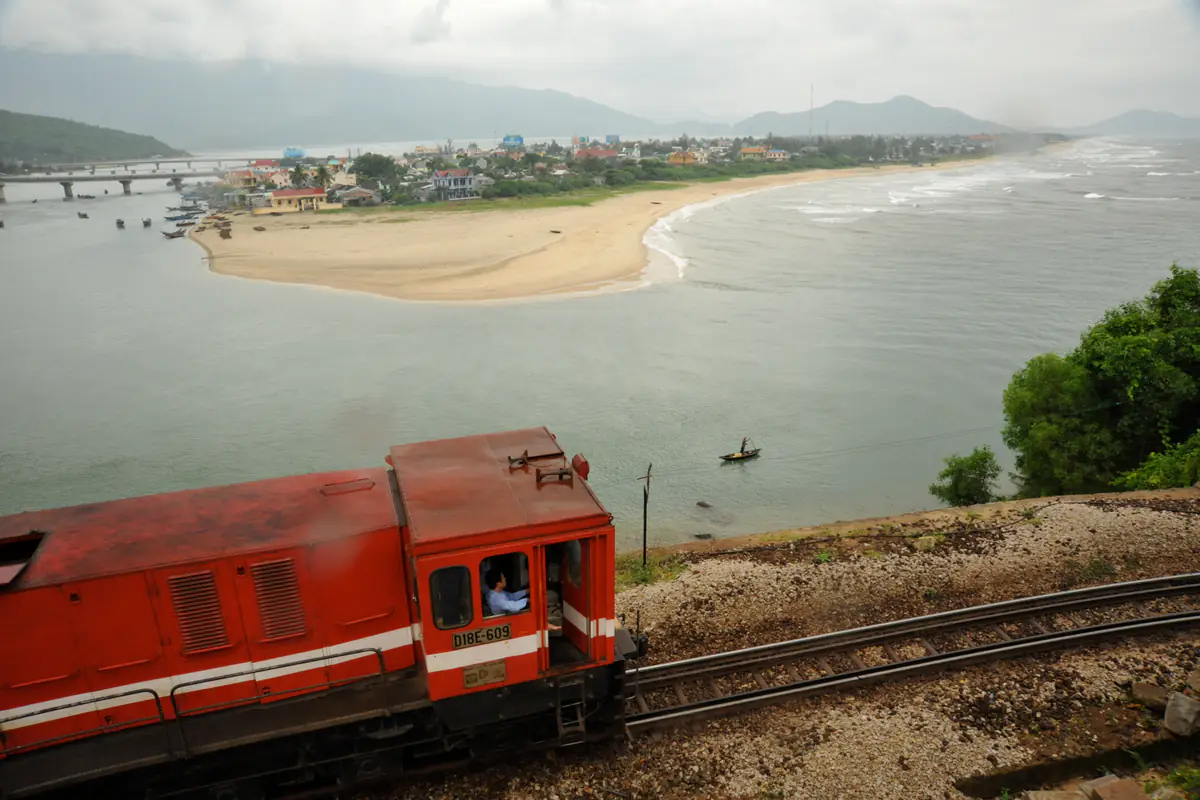
The train skirting Lang Co, the lagoon mouth on one side and sand on the other.
The HĐ1 heritage train leaves Hue at 7:05 AM and reaches Da Nang at 10:10 AM, offering a tourism-focused experience with upgraded carriages. The regular SE3 departs at 7:55 AM and arrives at 10:28 AM, making it faster and generally cheaper. Both travel along the spectacular railway through Hai Van Pass, but for the best sea views, you should book a window seat on the left side when traveling from Hue to Da Nang.
Which train should you take from Hue to Da Nang?
There are two main types of trains worth considering on the Hue - Da Nang route: the HĐ heritage trains and regular North-South passenger trains with SE service numbers.
Both use the same railway through Hai Van Pass. The heritage service does not operate on a separate sightseeing track.
The main differences are journey time, carriage design, onboard services, and ticket prices.
| Feature | HĐ heritage train | Regular SE train |
|---|---|---|
| Main purpose | Scenic tourism and cultural experiences | Regular passenger transport |
| Journey time | Around 3 hr 5 min to 3 hr 45 min | Often 2 hr 30 min to 2 hr 45 min |
| Seating | Soft seats, upgraded first class, and VIP options | Soft seats and sleeper berths, depending on train |
| Onboard experience | Cultural carriage and activities on selected services | Standard railway services |
| Ticket price | Usually higher | More budget-friendly options |
| Hai Van Pass views | Yes | Yes |
Choose HĐ1 for the full scenic experience
The HĐ1 is my first recommendation for anyone taking the railway through Hai Van Pass for the first time.
It departs Hue at 7:05 AM, passes through the Lang Co area in the morning, and reaches Da Nang at 10:10 AM.
You will be traveling during daylight, without giving up your entire afternoon.
The HĐ service is designed around tourism. Its upgraded carriages feature comfortable seating, larger windows, and more carefully designed interiors. As part of the 2026 upgrade, the train introduced a 32-seat VIP carriage and rotating seats in selected classes.
The trade-off is the higher fare.
HĐ1 makes sense for first-time visitors, photographers, couples, and international travelers who want the train ride itself to be part of their Vietnam trip.
Choose SE3 if you want to save time and money
The SE3 departs Hue at 7:55 AM and arrives in Da Nang at 10:28 AM on the 2026 timetable.
Its journey takes approximately 2 hours and 33 minutes, around half an hour less than HĐ1.
Standard soft-seat tickets also tend to cost less.
You still pass Lang Co and Hai Van Pass. You can still see the sea through the window. What you do not get is the heritage train's dedicated cultural experience.
For a journey of just over 100 kilometers, an air-conditioned soft seat is comfortable enough for most passengers.
There is little reason to pay for a sleeper berth unless you specifically need somewhere to lie down.
Choose HĐ3 if you need to leave Hue in the afternoon
The HĐ3 departs at 2:30 PM and arrives in Da Nang at 6:15 PM.
Its biggest advantage is giving you the whole morning in Hue.
However, it is not always as good as HĐ1 for coastal views.
During the final months of the year, sunset comes earlier, and rain or low cloud can reduce visibility. By the later part of the journey, the light may no longer be suitable for photography.
HĐ3 is still worth considering, especially on clear days. Just do not assume that every section of the journey will be brightly lit.
Hue to Da Nang train schedule in 2026
Train times should always be checked for your actual travel date.
The HĐ heritage trains have a relatively straightforward timetable, while SE train schedules may change with operational adjustments.
Heritage train timetable
In 2026, the HĐ heritage trains run on the following schedule:
| Train | Route | Departure | Arrival | Duration |
|---|---|---|---|---|
| HĐ1 | Hue - Da Nang | 7:05 AM | 10:10 AM | 3 hr 5 min |
| HĐ3 | Hue - Da Nang | 2:30 PM | 6:15 PM | 3 hr 45 min |
| HĐ2 | Da Nang - Hue | 7:05 AM | 11:03 AM | 3 hr 58 min |
| HĐ4 | Da Nang - Hue | 3:20 PM | 6:15 PM | 2 hr 55 min |
For a trip from Hue to Da Nang, you only need to look at HĐ1 and HĐ3.
Regular SE train timetable
These are the main SE departures from Hue to Da Nang in 2026:
| Train | Leaves Hue | Arrives Da Nang | Journey time |
|---|---|---|---|
| SE3 | 7:55 AM | 10:28 AM | 2 hr 33 min |
| SE19 | 8:50 AM | 11:35 AM | 2 hr 45 min |
| SE1 | 10:30 AM | 1:14 PM | 2 hr 44 min |
| SE7 | 7:43 PM | 10:15 PM | 2 hr 32 min |
| SE5 | 9:40 PM | 12:21 AM, next day | 2 hr 41 min |
Not every service is available on every date.
The practical choices are straightforward:
- Arrive before lunch: Take HĐ1 or SE3.
- Leave Hue later but still see the scenery: Consider SE1 at 10:30 AM.
- Travel at night without worrying about views: Look at the evening SE services.
SE7 and SE5 are poor choices if your main reason for taking the train is to see Hai Van Pass.
Most of the coastal scenery will be in darkness, especially during winter.
Also note that SE5 reaches Da Nang after midnight. Make sure your hotel reservation and onward arrangements match the correct arrival date.
How much does the Hue to Da Nang train cost?
Ticket prices depend on the train, seating class, travel date, and remaining availability.
On the heritage train, you also need to distinguish between standard seating, upgraded first class, and VIP tickets.
HĐ heritage train ticket prices in 2026
Heritage train fares in 2026 depend on the ticket class and day of the week:
| Ticket class | Monday-Thursday | Friday-Sunday |
|---|---|---|
| Standard | 180,000 VND | 210,000 VND |
| First class, A56 rotating seats | 220,000 VND | 250,000 VND |
| VIP, 32-seat carriage | 395,000 VND | 460,000 VND |
The actual fare for a given date may start from around 234,000 VND per person, one way, for both HĐ1 and HĐ3 between Hue and Da Nang.
Use the final price displayed during checkout as your actual fare.
For passengers mainly interested in the views, standard seating or first class should be sufficient.
VIP is worth considering if you prefer a quieter carriage, more personal space, a table beside the window, or a more distinctive interior.
There is no need to pay nearly twice as much simply because you hope to see more of the coastline.
A properly positioned window seat matters more than the ticket class.
Regular SE train ticket prices
Regular SE seats and berths on this route start from these prices in 2026:
| Train | Ticket class | Price from |
|---|---|---|
| SE7 | Soft seat | 83,000 VND |
| SE5 | Soft seat | 92,000 VND |
| SE1 | Soft seat | 155,000 VND |
| SE3 | Soft seat | 163,000 VND |
| SE19 | Four-berth sleeper | 284,000 VND |
These are starting fares for the listed accommodation types, not fixed prices for every seat or berth on those trains.
A single train may offer several fare categories.
For a useful comparison, HĐ1 starts from 234,000 VND and SE3 from 163,000 VND.
That is a difference of approximately 71,000 VND per passenger.
For two people, the difference comes to around 142,000 VND.
In return, HĐ1 provides a more tourism-focused experience and a slightly longer journey.
If you are traveling on a tight budget, SE3 is a sensible choice. You do not lose the mountain and sea views just because you take a regular train.
But when the train journey is one of the main activities of your day, paying more for HĐ1 can be worthwhile.
Should you book a return ticket?
Only book a return ticket if both travel dates are already fixed.
Vietnam Railways sometimes offers return-ticket discounts under specific promotions, but a discount does not automatically mean that changing your travel date is free.
If your plans may change, booking each direction separately gives you more flexibility.
If your hotels and travel dates are already confirmed, compare the available return fares before paying.
Which side of the Hue to Da Nang train has the best sea views?
Sit on the left side of the train when traveling from Hue to Da Nang.
This is the side that generally offers the best views of the sea along the most scenic sections around Lang Co and Hai Van Pass.
When traveling in the opposite direction, from Da Nang to Hue, choose the right side.
There is one important detail: left and right refer to the direction the train is moving, not necessarily the direction your seat faces.
Some seats may face backwards.
How to choose the right seat online
When the booking website displays the carriage seating plan, follow these steps:
- Step 1
Train and date
Select the correct train and travel date.
- Step 2
Carriage type
Choose an air-conditioned soft-seat carriage with good-sized windows.
- Step 3
Sea side
Identify the left side in the Hue - Da Nang direction.
- Step 4
Window seat
Pick a seat directly beside a window rather than the aisle.
- Step 5
Final check
Check the carriage and seat numbers before paying.
Do not rely only on odd or even seat numbers.
Carriage layouts vary, particularly after upgrades. A list of recommended seat numbers shared online in 2024 may no longer apply to the carriages operating in 2026.
If the booking diagram does not clearly show which end of the train is facing forward, ask the railway staff or ticket seller before purchasing.
Is the front or middle carriage better?
A middle carriage is generally a comfortable choice for passengers who want to sit and enjoy the scenery.
You may also have less distance to walk when moving around the train.
Carriages near either end sometimes provide interesting views of the train curving around the mountainside.
However, not every window offers that angle.
Whether you can see the train itself depends on the direction of the curve, train length, and window position.
If you can choose only one thing, prioritise a window seat on the sea-facing side.
The carriage number comes second.
On the upgraded HĐ services, rotating seats can make it easier to face the direction of travel. However, turning a seat does not change which side of the carriage overlooks the sea.
Will you see the sea for the entire journey?
No.
Between Hue Station and Hai Van Pass, the train travels through several different landscapes.
You will pass residential areas, fields, wetlands, hills, and railway infrastructure before reaching the most dramatic coastal sections.
Some views are blocked by vegetation, rock faces, or buildings.
The train also enters short tunnels, temporarily removing the outside view altogether.
Choosing the left side gives you the best chance of seeing the coastline during the most scenic parts. It does not guarantee uninterrupted sea views for three hours.
The most scenic sections of the Hue - Da Nang railway
The railway journey between Hue and Da Nang covers approximately 103 kilometers.
The section most passengers look forward to is not immediately outside Hue Station.
It is the stretch around Lang Co, Hai Van Pass, and the northern approach to Da Nang.
From Hue Station towards Lang Co
After leaving Hue, the train passes through residential neighbourhoods, fields, and low-lying countryside south of the city.
The scenery is relatively open. Depending on the section, you may see wetlands, distant mountains, and stretches of rural landscape.
Do not worry if the sea is not immediately visible.
The most dramatic section comes later.
On HĐ1, the train reaches Lang Co Station at 8:38 AM.
It is worth having your phone or camera ready before then.
For HĐ3, the Lang Co time is 4:42 PM.
These times are useful reference points, not exact predictions for when the sea will first appear outside your window.
Lang Co and the northern foot of Hai Van Pass
Around Lang Co, the scenery changes noticeably.
You begin to see pale stretches of sand, open water, and green mountain slopes rising close to the coast.
In places, the railway runs above sea level along the mountainside, creating the feeling of looking down onto the bay.
The wider area also includes Lap An Lagoon, surrounded by mountains near Lang Co Bay.
Depending on the railway's position and your window angle, you may see water, houses, boats, and mountain ridges in the distance.
This is a good moment to put your phone away from social media and concentrate on the view.
You do not have to take photos constantly.
Because the train is moving, scenery changes quickly. Holding a camera too close to a dirty or reflective window can also result in blurred images.
The railway through Hai Van Pass
This is the highlight of the journey.
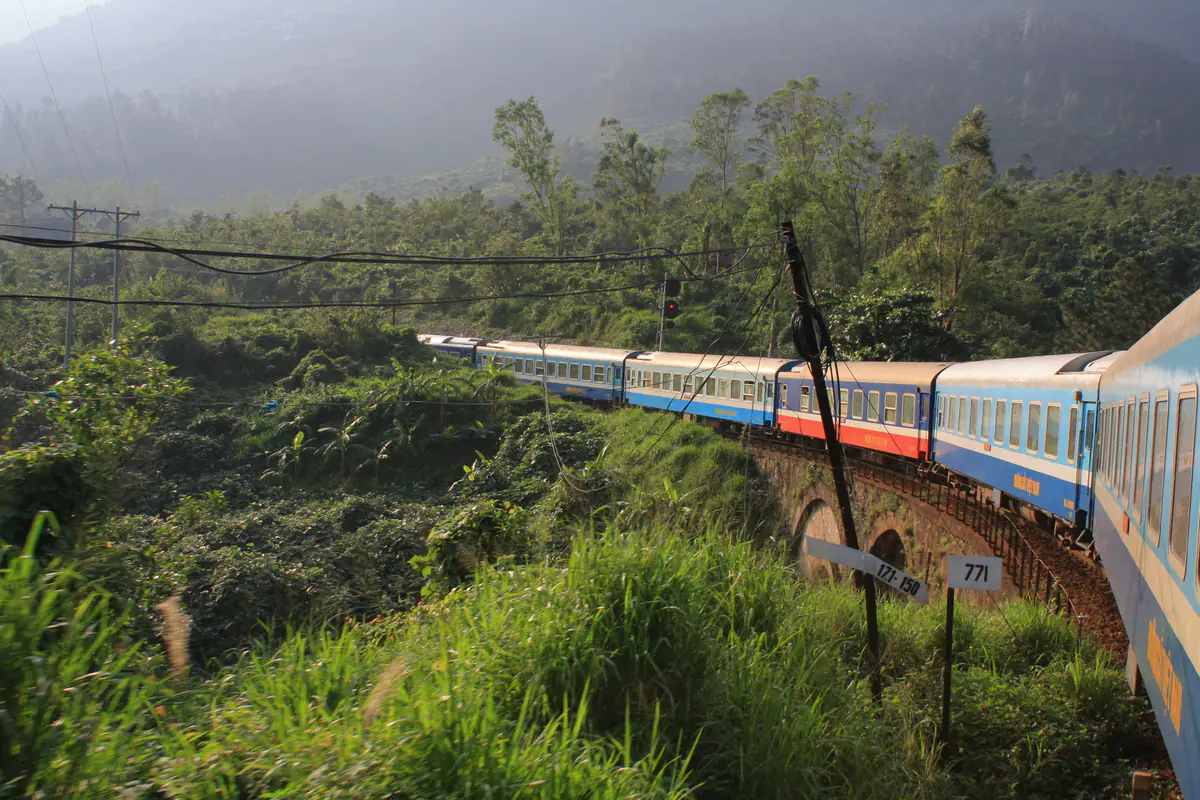
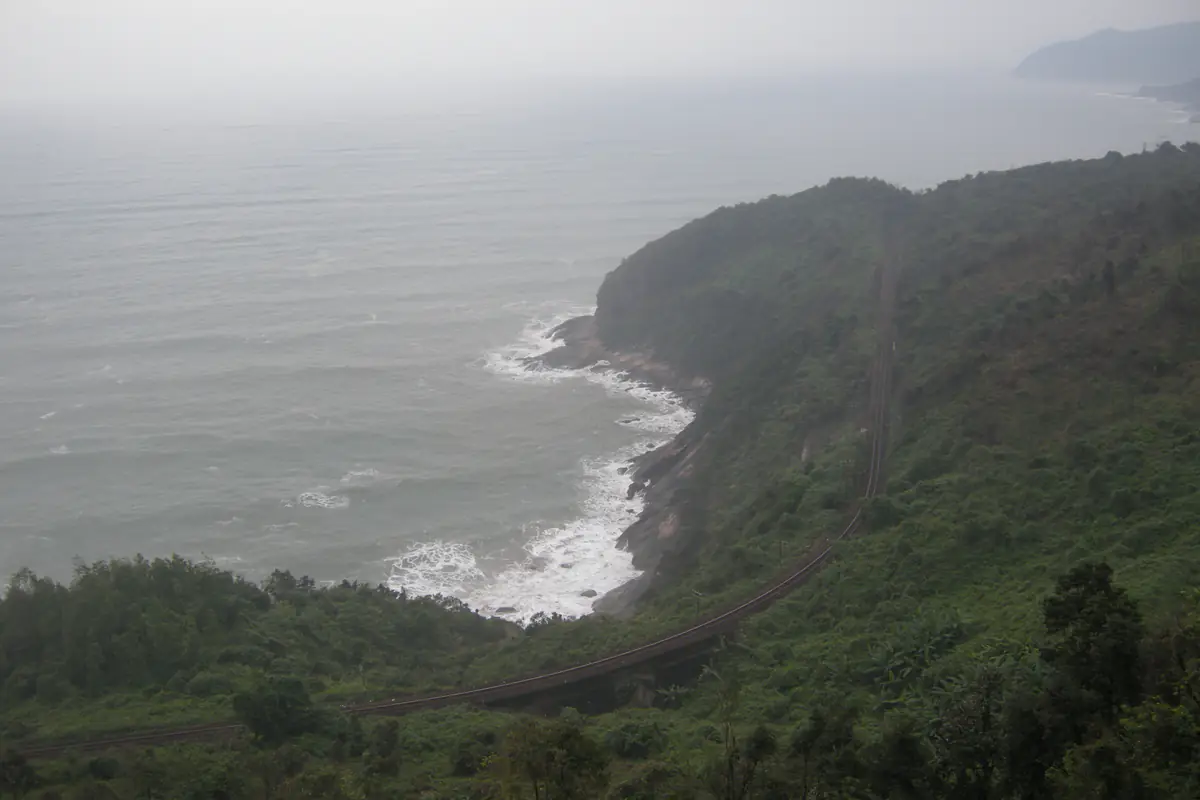
The railway follows the mountain's contours, crossing bends and railway bridges cut into the slopes.
Sometimes the sea appears far below. At other points, it is framed by dense greenery and steep terrain.
The railway offers a different perspective from the road because the tracks follow a lower route around parts of the mountain.
As the train negotiates a curve, you may briefly see part of the train ahead or behind you.
Those moments can produce excellent photographs, but they pass quickly.
Using burst mode or recording a short video is often more effective than trying to frame a single perfect picture.
From the southern foot of Hai Van Pass into Da Nang
After the pass, the landscape gradually opens towards Da Nang Bay and the surrounding urban areas.
You no longer have the same continuous stretches of steep mountainside beside the sea.
Instead, the railway enters increasingly developed areas, passing homes, roads, and railway facilities.
As the train approaches Da Nang Station, begin packing your belongings.
It is much easier to check your seat, collect bags, and prepare to disembark before the train comes to a complete stop.
Is the morning or afternoon train better?
For sightseeing, the morning is generally the better choice, especially if you can book HĐ1.
HĐ1 at 7:05 AM: best for sightseeing
This departure has three advantages.
First, you travel through the Hai Van area during daylight. On clear days, the coastal windows can offer pleasant morning light.
Second, you reach Da Nang at 10:10 AM, leaving enough time for lunch, hotel check-in, or dropping off your luggage.
Third, even if the train is slightly delayed, you still have some flexibility in your schedule.
The disadvantage is the early departure.
For a 7:05 AM train, aim to reach Hue Station at approximately 6:30 AM.
If you are staying in central Hue, arrange your transportation the night before or check how long it takes to reach the station from your accommodation.
SE3 at 7:55 AM: best for a straightforward journey
SE3 departs about 50 minutes later than HĐ1, yet its scheduled arrival is only around 18 minutes later.
You get a little more time in the morning without sacrificing daylight views.
This train makes sense if you have already tried the heritage service, want to reduce your travel costs, or simply want a scenic journey without additional onboard activities.
For families with young children, the shorter travel time can also be an advantage.
HĐ3 at 2:30 PM: consider the season
HĐ3 is useful when you need to stay in Hue until early afternoon.
During summer, the longer daylight hours make afternoon sightseeing more practical.
In the final months of the year, however, sunset comes earlier and the weather can be cloudier.
If the forecast shows heavy rain or low cloud, do not book HĐ3 specifically because you expect a dramatic sunset over the sea.
Even in good weather, sunset views depend on the actual conditions and the position of the train.
What is special about the Hue - Da Nang heritage train?
The Central Heritage Connection train, commonly called the Hue - Da Nang heritage train, officially began operating in 2024.
Two years later, in 2026, Vietnam's railway sector introduced an updated version of the service.
Its purpose is not simply to transport passengers between the two cities.
The train combines scenic travel with elements of regional culture.
Interiors inspired by Hue and Central Vietnam
The refurbished train features purple tones associated with Hue, alongside colors and decorative elements inspired by local heritage.
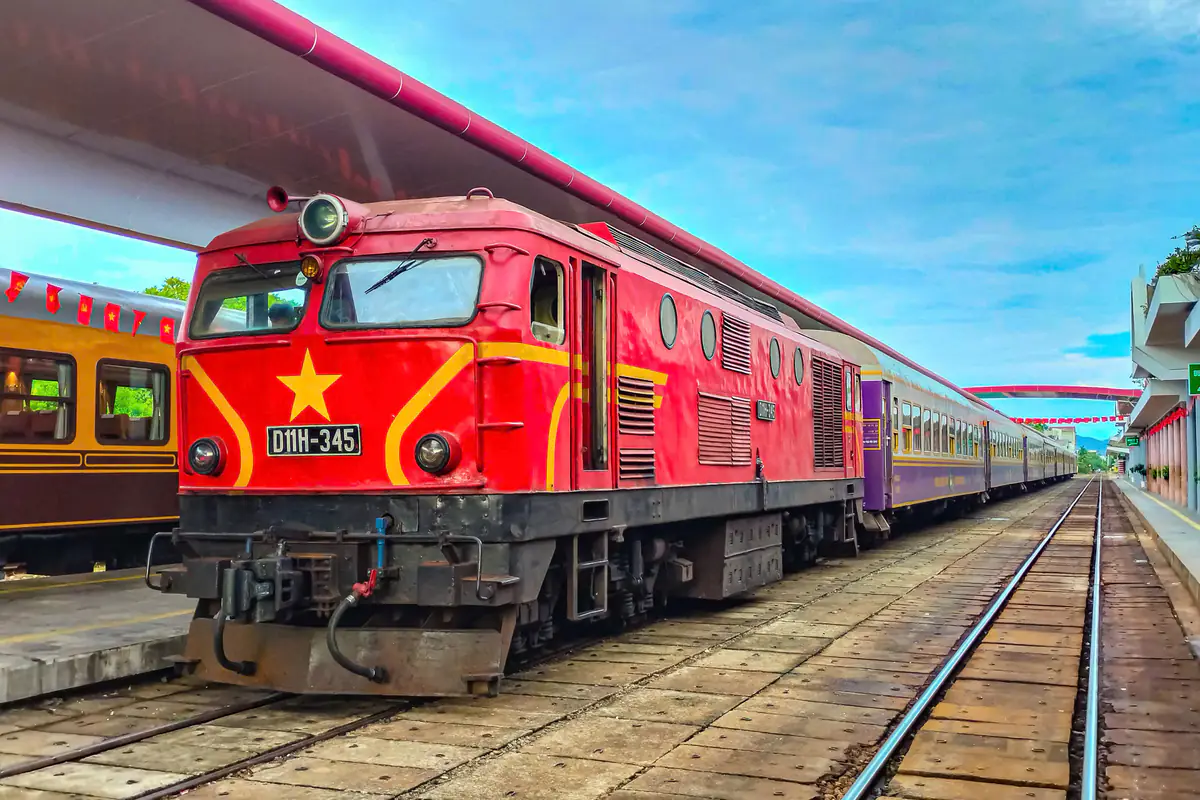
Selected upgraded carriages have soft seats that can rotate through 180 degrees.
This allows passengers to adjust their seating direction for greater comfort.
The interiors are designed to make the short journey more enjoyable while giving passengers good opportunities to look through the windows.
Not every carriage is the same, however.
When booking, make sure you understand whether you are paying for standard class, upgraded first class, or VIP.
The 32-seat VIP carriage
The VIP carriage is intended for travelers looking for more space and comfort.
Its interior takes inspiration from traditional design, with tables positioned near the windows and a different seating layout from the regular carriages.
VIP tickets include food-and-drink combination options.
The higher price makes this a premium choice rather than a necessity.
VIP may appeal to older travelers, couples, or anyone who wants a more relaxed setting.
But for photography, window position remains more important than the word "VIP" on your ticket.
The community carriage
One distinctive feature of the heritage service is its community carriage, used for cultural activities and the introduction of regional food.
Depending on the operating programme, passengers may encounter traditional music, local products, or other cultural experiences.
Do not assume that every departure includes the same performances.
If a particular activity is important to you, check with the operator or ticket seller before your travel date.
For a journey lasting about three hours, a comfortable seat, clean window, and working air conditioning are already enough to make the trip enjoyable.
The stop at Lang Co Station
The heritage train was introduced with a scheduled stop at Lang Co, allowing passengers an opportunity to appreciate the surrounding scenery.
The actual stopping time depends on railway operations.
If the stop is short, enjoying the view from your seat is the simpler option.
Where to buy Hue to Da Nang train tickets
You can buy tickets online or directly at the station.
If you want a specific window seat, booking ahead is useful because you can check which seats remain available.
Book through Vietnam Railways
The main official channels are:
- Vietnam Railways ticketing website: dsvn.vn
- Central Heritage Connection website: ketnoidisan.dsvn.vn
- Ticket counters at Hue Station and other authorised railway sales points
On the booking system, select Hue as your departure station and Da Nang as your arrival station.
Then choose your travel date.
Compare HĐ1, HĐ3, SE3, or SE1 depending on your preferred departure time.
The heritage train website is useful if you have already decided to travel on HĐ.
The main railway ticketing system is more convenient for comparing different train services.
Book through Vexere
Vexere also lists train tickets, departure schedules, seating classes, and seat maps for supported services.
The advantage is being able to compare multiple departures in one interface.
However, check the total payable price, ticket class, and cancellation conditions carefully.
A fare advertised as "from" a certain amount may not apply to the exact window seat you want.
If the seat shown at checkout differs from the one you selected, verify the details before paying.
Buy tickets directly at Hue Station
Hue Railway Station is located on Bui Thi Xuan Street, close to the city's central area.
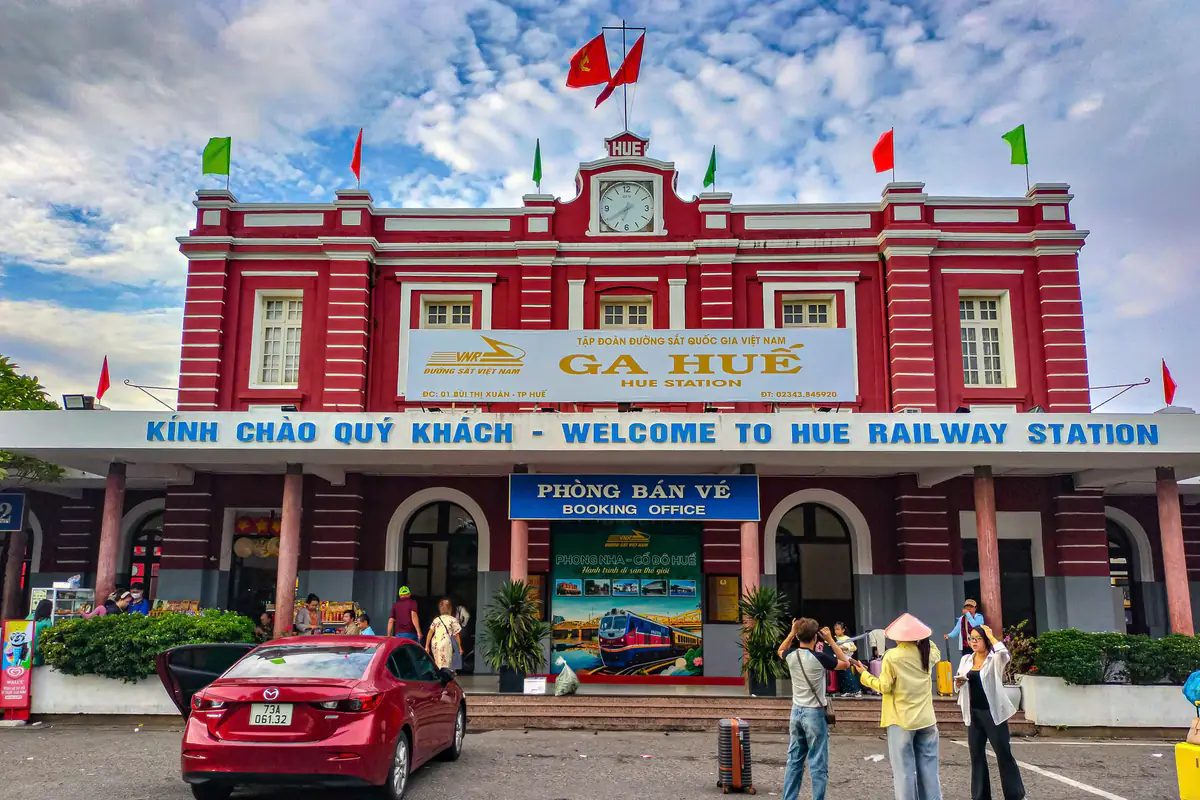
You can visit the ticket counter, provide your travel date, and ask the staff to help you find a sea-facing window seat.
This is useful if you are unfamiliar with online booking or need clarification about carriage layouts and ticket classes.
The disadvantage is that desirable seats may already be sold out, particularly on weekends and busy travel dates.
How can foreign tourists buy tickets?
International visitors can use their passports to enter passenger information when purchasing tickets.
The important thing is that the name and passport number match the identification document used when boarding.
Vietnam Railways has rules requiring passenger information on electronic tickets to correspond with valid identification.
Prepare the following before booking:
- Full name exactly as shown on your passport.
- Passport number.
- Travel date and departure and arrival stations.
- An email address or phone number to receive your booking details.
- An accepted payment method.
After purchasing, save the electronic ticket or QR code on your phone so it remains accessible without mobile internet.
You do not need to join a tour simply because you are a foreign traveler. Booking directly through the railway's ticketing system is a reasonable way to check schedules and fares.
What to prepare before taking the train
The journey is short, but arriving on time and packing sensibly will make it much easier.
Arrive at Hue Station about 30 minutes early
For HĐ1 at 7:05 AM, aim to arrive around 6:30 AM.
For SE3 at 7:55 AM, arriving around 7:20 AM is sensible.
You need time to check your ticket, find the platform, identify your carriage, and bring your luggage aboard.
Do not plan to arrive at the station at the exact departure time.
Trains are not required to wait for late passengers.
Allow extra time if you are traveling with young children, older relatives, or several large bags.
Keep your luggage manageable
Vietnam Railways applies hand-luggage rules, with a standard passenger hand-luggage allowance of up to 20 kg.
Oversized or heavier items may require a different transport arrangement, so check the relevant rules before traveling.
For a three-hour journey, one medium suitcase and a small personal bag are much easier to manage than several loose bags.
Keep your phone, wallet, passport, ticket, and power bank in your personal bag.
Once aboard, find somewhere suitable for your luggage before taking out your camera.
Bring a little food and water
The heritage service offers certain food-and-drink options depending on ticket class and onboard arrangements.
However, you should not depend entirely on the train having the particular food you want.
For an early departure, have a light breakfast before leaving your hotel.
A bottle of water and a few snacks should be enough for most passengers.
If you are traveling with children, familiar snacks can be more convenient than searching for something suitable onboard.
Avoid bringing strongly scented food into an enclosed air-conditioned carriage.
How to take clear photos through the train window
Train windows often reflect the lights and interior of the carriage.
To reduce reflections, hold your phone's camera close to the glass without pressing hard against it.
Turn off the flash.
In bright sunlight, adjust your angle to avoid reflections from lamps, seats, and other objects inside the train.
For mountains, sea, and railway curves, landscape-oriented photos usually capture more of the scenery.
Do not put your phone, camera, arms, or head outside train windows or doors.
Some sections pass close to vegetation, rocks, and railway infrastructure.
If you move to take photographs, follow staff instructions and keep aisles and doors clear.
What is the best weather for the Hai Van Pass train journey?
Unlike the timetable, which can be checked in advance, weather around Hai Van Pass is difficult to predict precisely several days ahead.
The mountains sit directly beside the sea.
Cloud, rain, and mist can reduce visibility quite suddenly.
March to August
These months generally offer better opportunities for bright conditions and longer-distance views.
On clear days, Lang Co Bay can show its distinctive blue water, pale sand, and green mountain slopes.
However, summer does not guarantee perfect weather.
Strong sunlight, thunderstorms, and cloud-covered mountains are still possible.
If you are booking close to your travel date, check the forecast for rain and cloud around Hai Van Pass.
September to December
Central Vietnam experiences wetter conditions during this period, particularly when strong weather systems affect the region.
On some days, the mountains are almost completely covered in cloud.
The atmosphere can still be beautiful, but you may not see the full coastline.
Should you wait for a sunny day before booking?
That depends on how flexible your itinerary is.
If you have a fixed travel date, book your preferred window seat early.
A good seat on the correct side is often more valuable than waiting for a perfect weather forecast.
If you are staying in Hue for several days and have no fixed onward plans, you can monitor the weather and make your decision closer to departure.
The risk is that sea-facing window seats may sell out, particularly on HĐ heritage services during weekends.
Which train works best for different travelers?
There is no single best train for everyone.
The right choice depends on whether you care most about scenery, cost, comfort, or arrival time.
Solo travelers who enjoy photography
Choose HĐ1 with a left-side window seat.
You get a longer scenic journey, access to the heritage train experience, and an arrival in Da Nang before lunchtime.
There is no need to buy a VIP ticket just for photography.
Spend the extra money only if the upgraded carriage or added comfort genuinely matters to you.
Couples traveling on a budget
Compare HĐ1 and SE3 for the same date.
If HĐ1 has two suitable seats and the price difference fits your budget, it is worth considering.
But if HĐ1 only has aisle seats while SE3 still offers a sea-facing window, SE3 may provide the better sightseeing experience.
Both trains use the same railway through Hai Van Pass.
Traveling with older family members
Prioritise a convenient departure time, comfortable soft seats, and easy access within the carriage.
There is no need to choose the earliest train at all costs.
Someone who does not enjoy getting up at 5 AM may prefer SE1 at 10:30 AM.
Avoid unnecessary movement around the train and choose seating that is comfortable for the passenger.
If anyone needs help boarding or leaving the train, contact station staff.
Traveling with young children
SE3 has the advantage of a shorter journey.
HĐ1 offers a more distinctive tourism experience.
Children who enjoy trains, mountains, and the sea may find the heritage service particularly interesting.
However, with younger children, sitting beside a parent, having familiar food, and staying comfortable may matter more than onboard cultural activities.
Do not book seats far apart just to secure two attractive windows.
Travelers with plans in Da Nang before lunch
Choose HĐ1 or SE3, but allow extra time between the scheduled arrival and your next appointment.
For example, HĐ1 is scheduled to arrive at 10:10 AM.
You still need to get off the train, leave the station, and travel to your next destination.
Avoid scheduling an activity that requires you to arrive somewhere else at 10:20 AM.
Even a small train delay can disrupt an overly tight itinerary.
Common mistakes when booking Hue to Da Nang train tickets
The most common mistake is booking the correct route but choosing the wrong conditions for sightseeing.
Choosing the wrong side of the train: From Hue to Da Nang, the left side generally offers the best coastal views. A seating diagram can be misleading when the direction of travel is unclear.
Booking a sleeper berth for sightseeing: Sleeper berths are useful for resting, but they are not necessarily the best place to watch and photograph scenery. A soft window seat is usually more practical.
Choosing a cheap night train: SE7 or SE5 may save money, but you will see little of Hai Van Pass in the dark. Choose these services for transport, not sightseeing.
Using an outdated timetable: The heritage train's departure times have changed since its launch. Check your date on the current ticketing system.
Confusing standard and VIP prices: The same HĐ service can have several ticket classes. Check exactly which class is included in the advertised fare.
Booking too late for window seats: On weekends and busy dates, sea-facing seats may sell out before other seats.
Arriving too close to departure: Trains operate on a fixed schedule. Arrive around 30 minutes early and follow boarding announcements.
Getting off at Lang Co without permission: Only leave the train when staff allow it. Never wander onto railway tracks or away from the platform to take photographs.
Entering incorrect identification details: Your electronic ticket should match the identification document you use when boarding. International travelers should double-check their passport numbers before paying.
Another easily overlooked mistake is selecting the wrong arrival station.
Some ticketing platforms display broader geographical areas as well as specific station names.
Make sure the ticket shows Da Nang Station as your destination if you intend to finish the journey at the railway station in central Da Nang.
A simple morning itinerary for the Hai Van Pass train
If you want the train journey to be a sightseeing experience rather than just transport, the following HĐ1 plan is practical.
- 6:20-6:30 AM
At the station
Arrive at Hue Station and find your carriage.
- 7:05 AM
Departure
HĐ1 departs.
- Before 8:30 AM
South of Hue
Enjoy the countryside south of Hue and prepare your camera.
- 8:30-8:40 AM
Near Lang Co
Around this time, watch for the Lang Co area.
- After Lang Co
Hai Van railway
Concentrate on the coastal railway through Hai Van Pass.
- 10:10 AM
Arrival
Scheduled arrival at Da Nang Station.
- 10:20-10:40 AM
Leave the station
Leave the station with your luggage and continue your journey.
The intermediate times are approximate sightseeing references, not guaranteed arrival times at specific viewpoints.
If you choose SE3, you can aim to reach Hue Station around 7:20 AM, board the 7:55 AM service, and arrive at Da Nang Station at approximately 10:28 AM.
Both options leave most of the day available after arrival.
There is no need to rush into another sightseeing activity immediately.
Collect your bags, leave the station, and confirm your hotel's location first.
If you have a large suitcase, taking a car from the station will usually be more convenient than walking a long distance in the heat or rain.
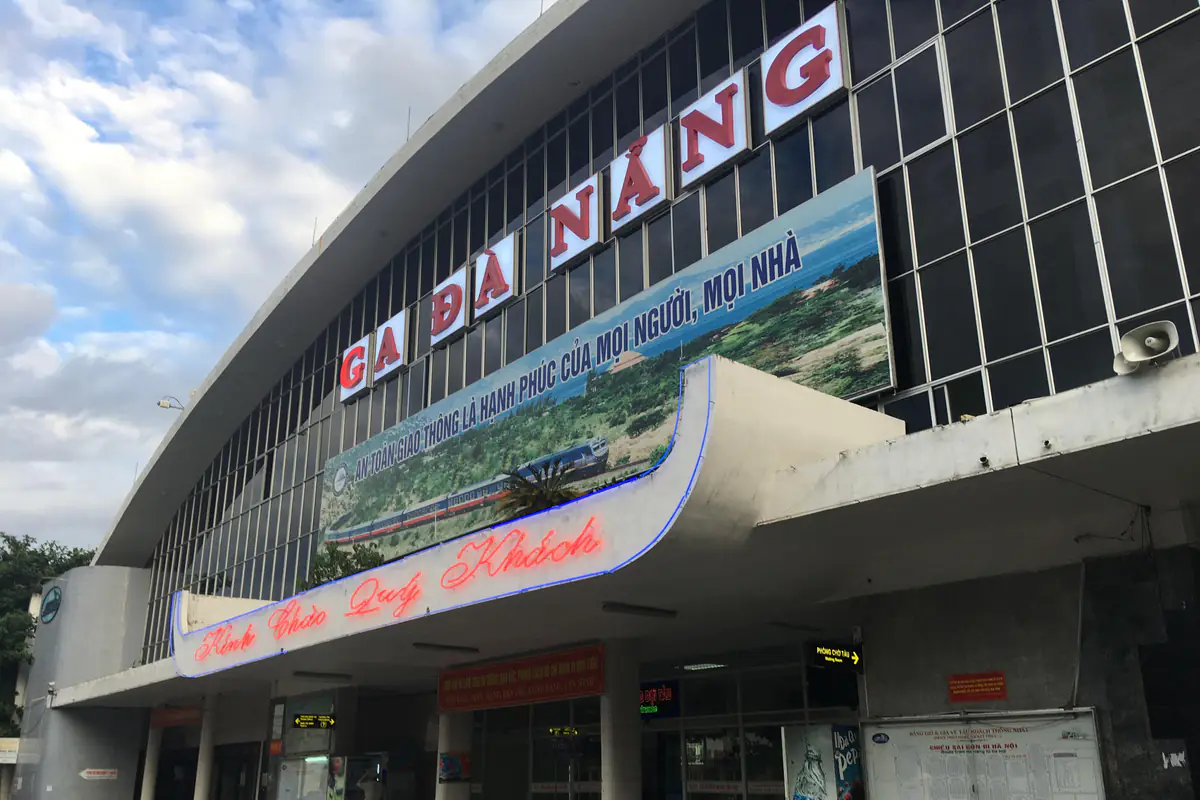
For your first journey along the Hai Van railway, start by checking HĐ1 at 7:05 AM on the Central Heritage Connection booking website and look for a left-side window seat. If the best seats are unavailable or you would rather save money, check SE3 at 7:55 AM instead. Both travel through the scenic Lang Co - Hai Van section during daylight.
FAQ
How long is the train journey from Hue to Da Nang?
Regular SE trains commonly take around 2 hours and 30 minutes to 2 hours and 45 minutes. On the 2026 timetable, the HĐ1 heritage train takes 3 hours and 5 minutes, while HĐ3 takes 3 hours and 45 minutes. Actual travel times may vary due to railway operations.
How much does the Hue to Da Nang train cost?
In 2026, soft seats on selected SE trains start from approximately 83,000 VND. HĐ1 and HĐ3 heritage train tickets run from 180,000 to 460,000 VND depending on class and day of the week, and the actual fare for a given date may start from around 234,000 VND per person, one way. Upgraded and VIP tickets cost more, and prices should always be checked for your actual travel date.
Which side of the Hue to Da Nang train should I sit on?
Choose the left side in the direction of travel from Hue to Da Nang. It generally provides the best sea views around Lang Co and Hai Van Pass. For the opposite direction, choose the right side. Do not rely solely on odd or even seat numbers because carriage layouts can vary.
Does the Hue to Da Nang heritage train stop at Lang Co?
Yes. The HĐ heritage service includes a scheduled stop at Lang Co Station. However, the stopping time and permission to leave the train depend on the actual operating arrangements. Always follow railway staff instructions.
Is the HĐ1 heritage train better than SE3?
Choose HĐ1 if you want upgraded tourist carriages, cultural experiences, and a more leisurely trip. Choose SE3 if you want a cheaper ticket and a shorter journey. Both follow the railway through Hai Van Pass during daylight on the 2026 schedule, so choosing a good window seat is still essential.