Ha Giang buckwheat flowers: stay in Dong Van or Meo Vac?
Dong Van is the better base for spending two days among the buckwheat fields, while Meo Vac makes more sense if you want to complete the mountain loop and see Ma Pi Leng Pass. With only four days, trying to fit in both means sacrificing time at some of the best flower locations.
By Da Lat LoversPublished Updated
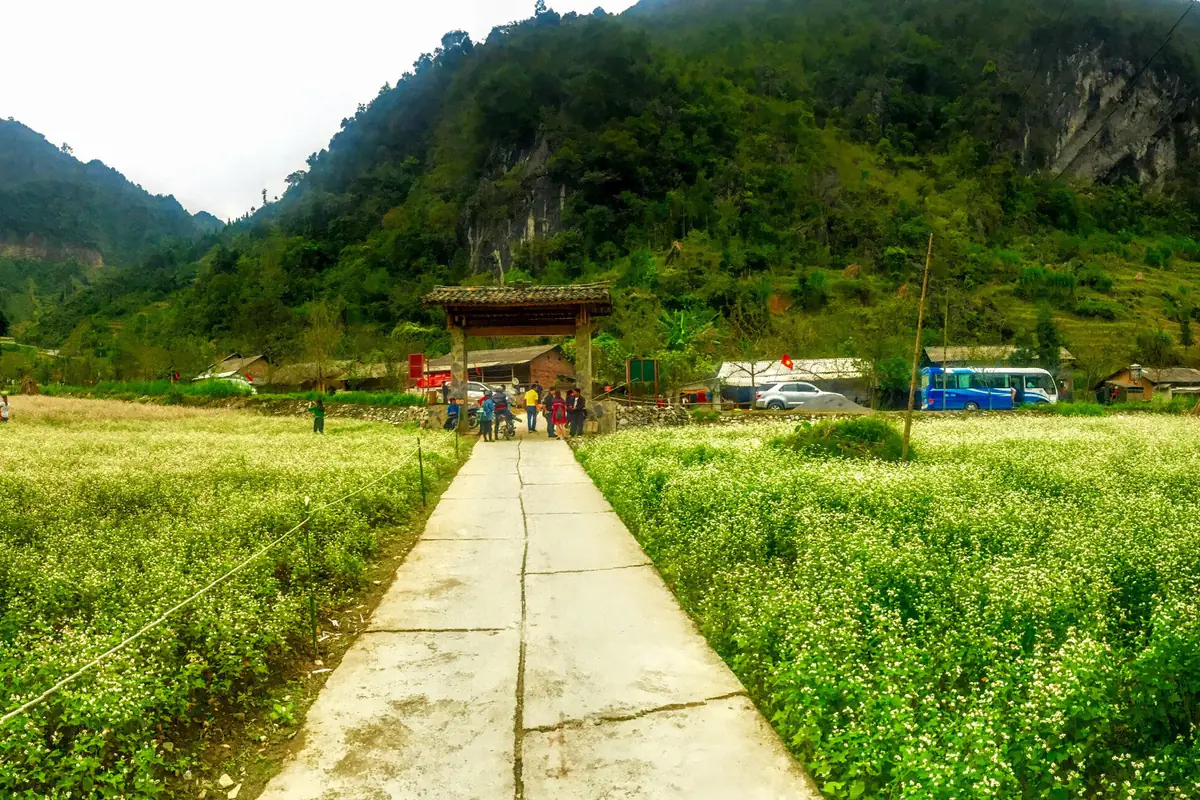
White buckwheat flowers line the garden path in Sung La.
Start by marking three places on your map: Sung La, Sa Phin, and Lung Cu. These are the areas worth prioritizing if you want to see Ha Giang's buckwheat flowers, which are usually at their best from late October through November. With four days, you can travel from Ha Giang through Yen Minh, spend two nights in Dong Van, set aside a day for Lung Cu, and return without constantly packing your bags or rushing between destinations.
When is the best time to see buckwheat flowers in Ha Giang?
Late October to mid-November is generally the safest period to plan around. Buckwheat flowers usually begin appearing in October, bloom across several areas in November, and may remain visible into December in fields planted later in the season.
There is no single peak blooming date for all of Ha Giang. Buckwheat is a cultivated crop, and farmers sow their fields at different times. One hillside may already be covered in deep pink flowers and developing seeds, while another field just a few kilometers away still has fresh white blossoms.
For the 2026 season, local authorities arranged three planting phases across the Dong Van Karst Plateau, aiming to maintain flowering landscapes from October through the end of December. That gives late visitors a chance to see flowers, but it does not mean every field stays in bloom for three consecutive months.
| Period | Typical flower conditions | Should you visit? |
|---|---|---|
| Late September - early October | Some early-planted fields may begin flowering | Possible, but not the first choice |
| Mid-October | More fields show white and pale pink blossoms | Good for an early-season trip |
| Late October | Many areas enter a favorable flowering period, with festival activities beginning | Highly recommended |
| Early to mid-November | Usually a wider choice of flowering fields across different locations | Best overall choice |
| Late November | Some fields remain beautiful; others have aged or been harvested | Check individual locations |
| December | Flowers depend largely on later planting rounds | Go specifically for flowers only after checking recent conditions |
Why is November so popular?
November falls within the cooler autumn-to-winter period on the Dong Van Karst Plateau. Temperatures drop, particularly in the mornings around Dong Van and Lung Cu, and the small fields of flowers become part of the mountain scenery.
What makes this season special is the setting. Buckwheat grows among limestone mountains, terraced plots, stone fences, and traditional earthen houses. The flowers are relatively small, but their white and pink colors stand out against the gray rock.
The flowers also change color as they mature. Fresh blossoms tend to be white or pale pink, gradually turning deeper pink, purple-pink, and eventually darker as the plants age and develop seeds.
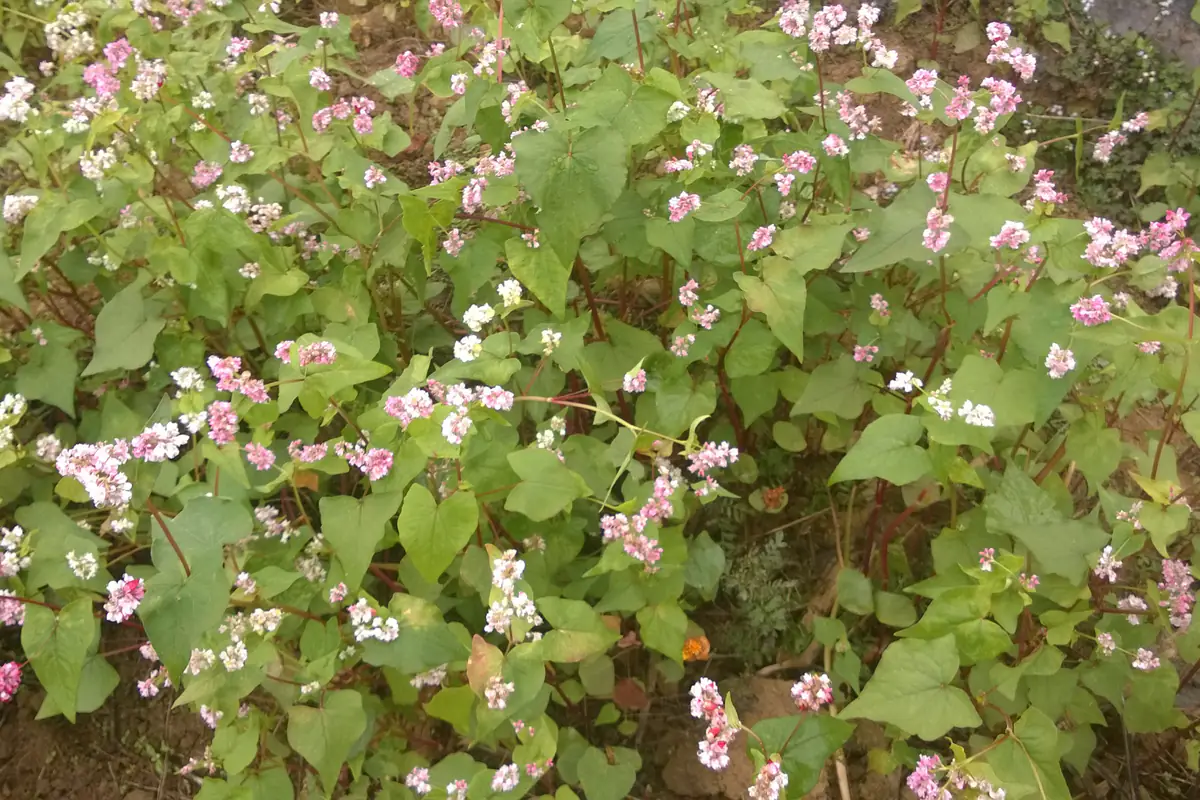
Do not choose your travel dates based on a single photograph of an entirely pink hillside. That photo may have been taken in a different year, during another planting cycle, or at a privately maintained flower garden.
Are the buckwheat flowers blooming in Ha Giang in 2026?
Yes.
Fields across the Dong Van Karst Plateau were already flowering in October 2026, including areas around Pho Bang and Lung Cu. The flower season has carried on into early November alongside the region's festival activities.
This is a suitable period to visit. However, flowering conditions vary between fields, so it is still worth checking which places are looking their best before setting out.
Where can you see buckwheat flowers in Ha Giang?
The best-known flower areas are on the Dong Van Karst Plateau, particularly along the route through Quan Ba, Yen Minh, Pho Cao, Sung La, Sa Phin, Dong Van, and Lung Cu.
Since July 2025, the former Ha Giang Province has been part of Tuyen Quang Province following Vietnam's administrative reorganization. However, Ha Giang remains the name most commonly used by travelers, especially in searches for the Ha Giang Loop and Ha Giang buckwheat flowers.
You can still find these familiar destinations under their traditional names on maps and travel platforms.
The locations below follow the general direction of travel from the southern entrance to the highlands toward Dong Van.
Sung La and Lung Cam Village
The first place to prioritize, allow 60-90 minutes
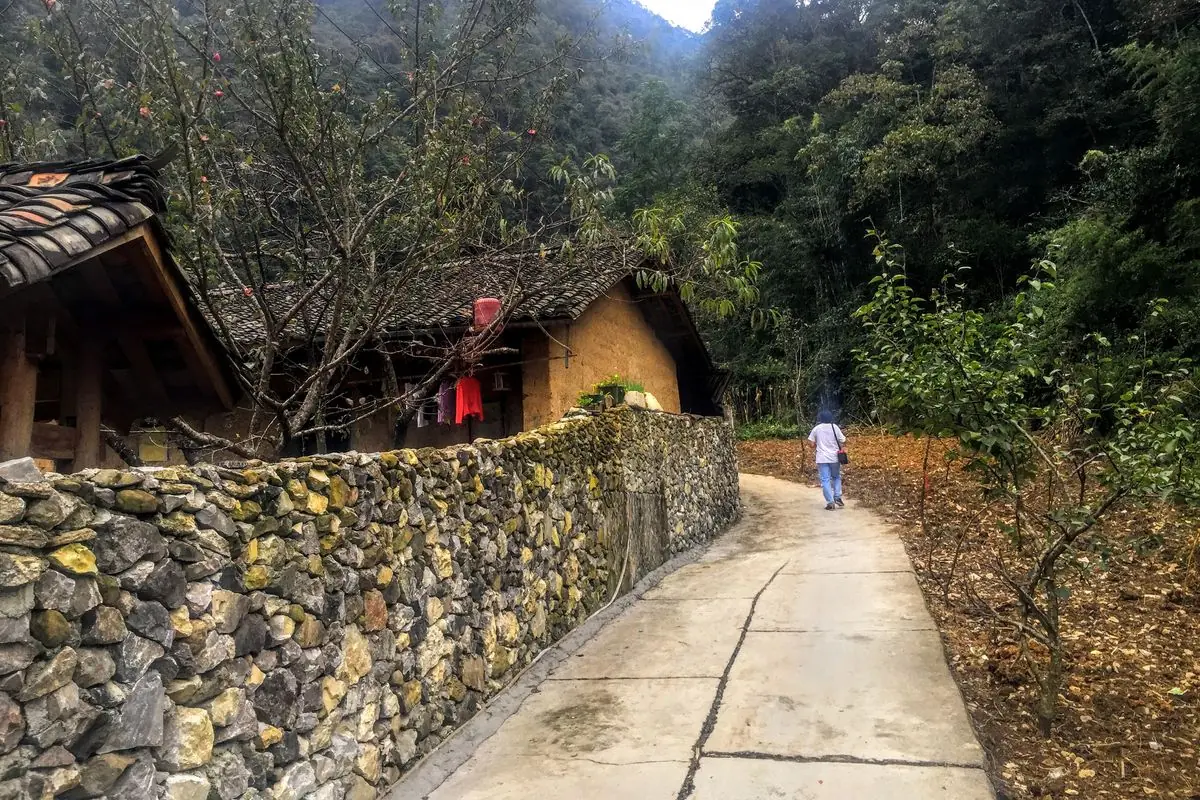
Sung La is one of the strongest choices if you want to see buckwheat flowers surrounded by a mountain valley, limestone peaks, and traditional earthen houses.
The area lies along the main route from Yen Minh to Dong Van, close to Lung Cam Cultural Village and the House of Pao.
During flower season, buckwheat fields appear among the village's agricultural plots, giving you a setting quite different from a landscaped flower garden in a city.
The appeal is not limited to the flowers themselves. Stone fences, old tiled roofs, yellow earthen walls, and the surrounding mountains are just as important to the scenery.
A small patch of flowers beside a traditional house can be more interesting than a larger garden filled with decorative photography installations.
Allow around 60-90 minutes here. Walk through the village, look for a field that is currently flowering well, and take your photographs without trying to visit three or four nearly identical gardens.
Morning is a comfortable time to visit. On an overcast day, you have more flexibility because the light is softer throughout much of the day.
Pho Cao and Tham Ma Pass
Short stops along the road
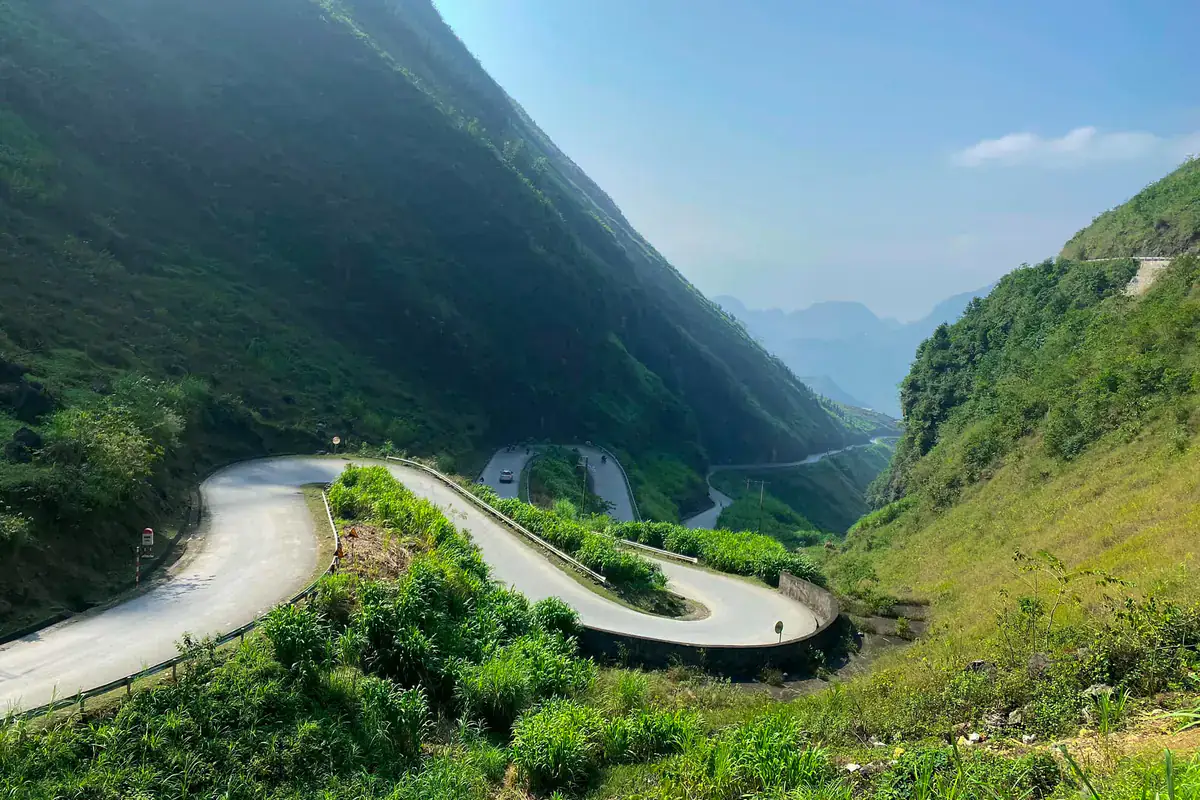
Tham Ma Pass lies along the road from Yen Minh toward Dong Van, before the Pho Cao and Sung La areas.
It is famous for its winding mountain road and viewpoints overlooking the surrounding landscape. During buckwheat season, some areas along this route may also have flowers planted for visitors.
However, Tham Ma is better treated as a short scenic stop than somewhere to spend an entire morning searching for flowers.
Take a look at the mountain road, photograph the scenery from a suitable viewpoint, and continue toward Sung La.
Pho Cao works in much the same way. Its beauty comes from the combination of village houses, small agricultural fields, and limestone mountains.
You do not need to find a particularly large flower garden to make the stop worthwhile.
Sa Phin
Combine flowers with the Hmong King's Palace
Sa Phin is another useful stop on the road toward Dong Van.
It is home to the Vuong Family Mansion, commonly called the Hmong King's Palace, one of the area's best-known historical and architectural attractions.
Sa Phin was also included among the locations designated for flower planting during the 2026 festival season.
A practical route is to visit Sung La first, then continue to Sa Phin. Both places are on the same general direction of travel, so there is no need for extensive backtracking.
Allow around an hour in Sa Phin, or longer if you are particularly interested in the mansion.
If you have already spent most of the morning photographing flowers in Sung La, there is little reason to search for several more similar gardens here.
Pho Bang
Better for traditional village scenery
Pho Bang, also frequently called Pho Bang Old Town or Pho Bang Village, is known for its old houses, narrow village roads, and agricultural plots surrounded by limestone mountains.
For the 2026 season, the area was among the locations where flowers were planted as part of the regional festival preparations.
Its appeal is the traditional village setting rather than large photography installations.
There is one practical drawback: Pho Bang requires a detour from the main route. Entering the village and returning to the road can take considerable time, especially if you stop to walk around.
Add Pho Bang if you have confirmation that its flowers are in good condition or if you particularly want to see the old village.
For a four-day trip focused on buckwheat flowers, Sung La and Lung Cu should generally take priority.
Dong Van
The most convenient place to stay
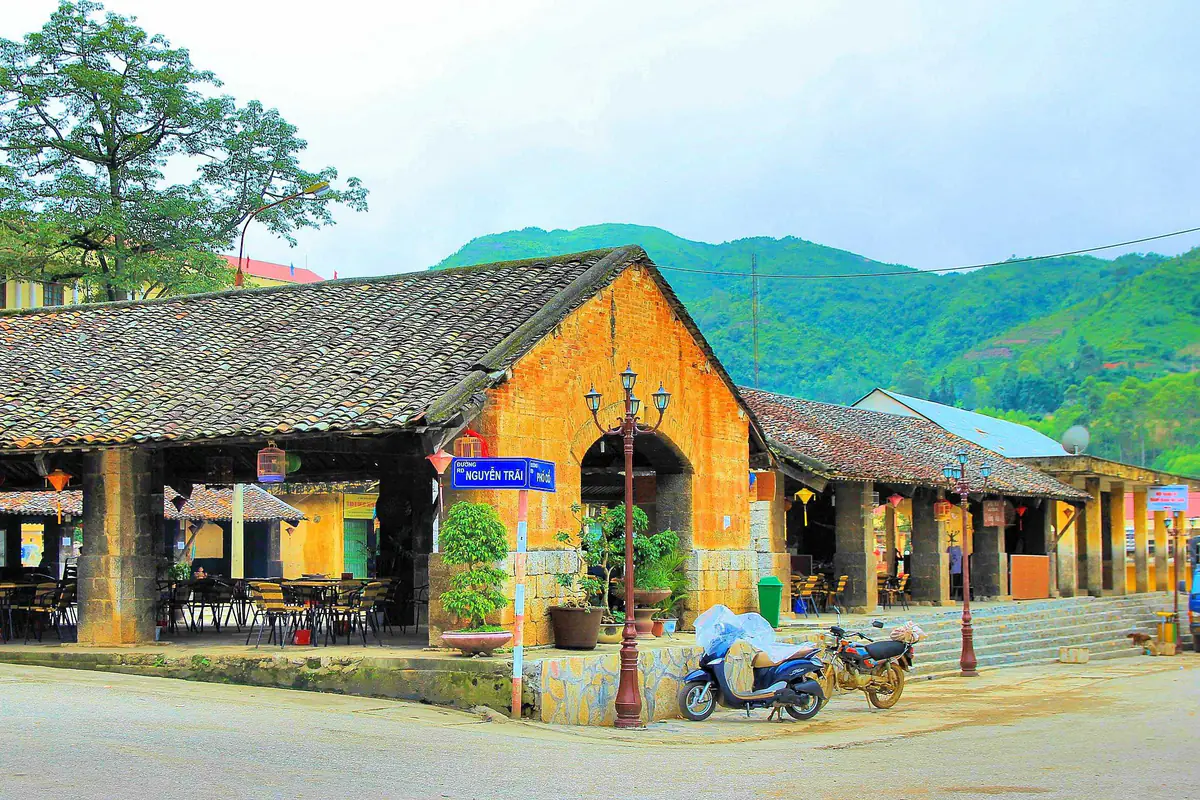
Dong Van is not one enormous flower garden. Buckwheat fields are spread across nearby villages, agricultural areas, and routes leading into the surrounding highlands.
Its main advantage is convenience.
Dong Van has accommodation, restaurants, and a practical location for reaching both Sa Phin and Lung Cu. In the evening, you can walk through the old quarter, have dinner, and rest without another long journey.
First-time visitors sometimes spend too much time searching for a place listed simply as "Dong Van Buckwheat Flower Garden."
In reality, many gardens operate seasonally. They can change planting locations or stop welcoming visitors once the flowers are harvested.
A better approach is to ask your accommodation which nearby fields are currently flowering well, then choose a location that fits your next day's route.
Lung Cu, Ma Le, Then Pa, and San Tro
Allow a separate morning, about 25 km from Dong Van
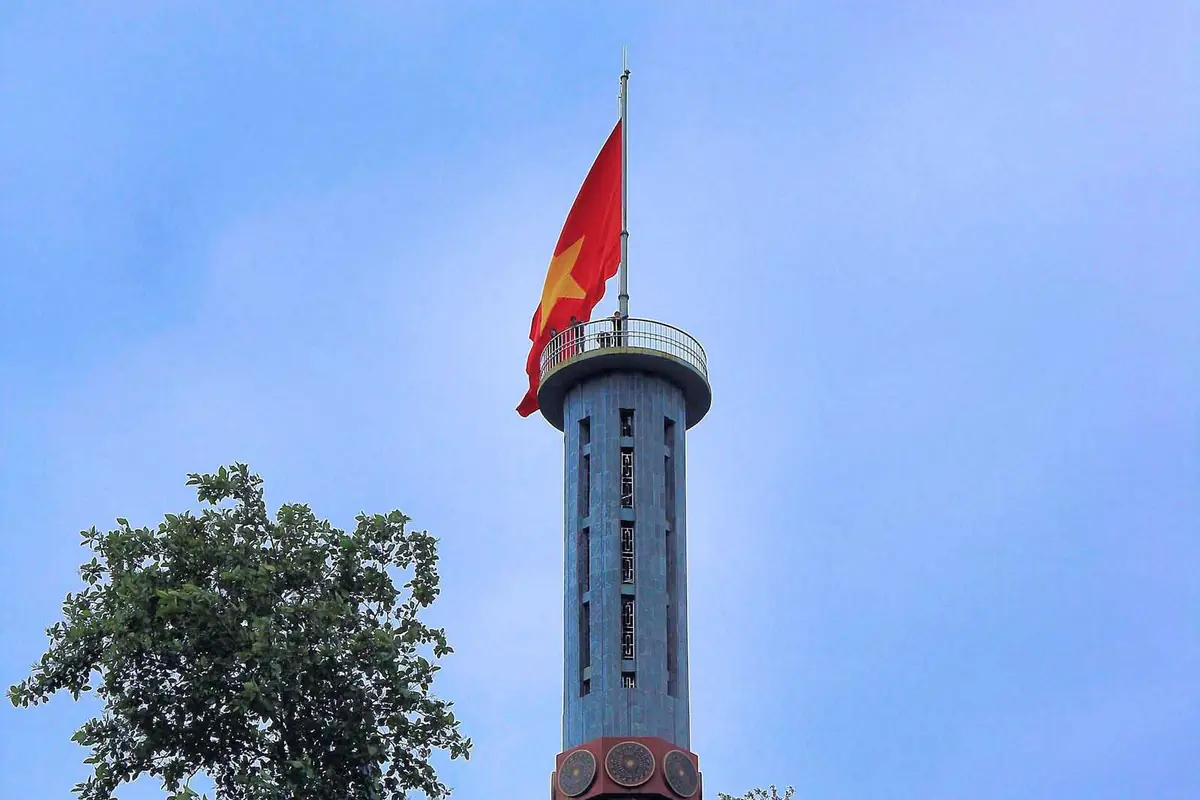
Lung Cu is one of the most worthwhile areas to visit during Ha Giang's buckwheat flower season.
It is known for the Lung Cu Flag Tower, Lo Lo Chai Village, and the agricultural fields scattered among villages near Vietnam's northern border.
For 2026, the villages of Then Pa, Lo Lo Chai, San Tro, Ma Le, and Ma So all had areas set aside for flower cultivation and tourism development.
You do not need to visit all five.
Choose one or two areas where flowers are currently at their best, then allow time to enjoy the surrounding landscape.
The road from central Dong Van to Lung Cu is approximately 25 km each way. Allow roughly an hour for the journey, depending on road conditions and stops.
Leave Dong Van in the morning and aim to return by mid-afternoon. This keeps the day comfortable and avoids having to squeeze Ma Pi Leng Pass into the evening.
Meo Vac, Pa Vi, and the Nho Que River
Beautiful, but not the priority
Meo Vac is better known for its mountain landscapes, Ma Pi Leng Pass, and the dramatic valley of the Nho Que River.
During festival season, areas around Pa Vi and certain routes near the river may also have buckwheat flower displays.
However, these locations are spread farther apart and are less convenient than Sung La, Sa Phin, Dong Van, and Lung Cu if your main purpose is flower photography.
Choose Meo Vac if you want to continue along the Ha Giang Loop and experience more mountain scenery.
For a dedicated four-day buckwheat flower trip, you do not need to reach Meo Vac simply to feel that you have covered Ha Giang properly.
When is the Dong Van buckwheat flower festival in 2026?
The 12th Buckwheat Flower Festival officially opened at 8:00 PM on October 25, 2026, at Thanh Nien Square in Dong Van, Tuyen Quang Province.
The theme of the festival was "Am Vang Mien Da," which can be translated as "Echoes of the Rocky Highlands."
The event celebrates the landscape and cultural traditions of the Dong Van Karst Plateau through performances, tourism activities, local products, and community events.
Festival-related experiences and seasonal activities continue through the final months of the year, with the broader flower festival program extending until the end of December 2026.
Do you need to visit on opening night?
No, unless you particularly want to see the official cultural performances.
The opening ceremony is a scheduled event, while the flowers bloom over a much longer period.
You can visit after the opening and still find beautiful flowering fields across the plateau.
The advantage of visiting during the opening celebrations is the atmosphere. There are performances, cultural activities, and more visitors gathering in the town.
The trade-off is that central Dong Van can become busier, accommodation may need to be booked earlier, and moving around popular attractions can take longer.
If you mainly want to see flowers, photograph villages, and walk through the countryside, a weekday trip will often be more comfortable.
What else happens during the festival?
Festival activities typically feature the culture and everyday traditions of communities living across the Dong Van Karst Plateau.
The 2026 program includes presentations of local products, cultural performances, traditional crafts, and tourism experiences in different parts of the region.
Around Dong Van, you can also explore the old quarter, browse local products, and try buckwheat cakes.
These cakes are made using flour from buckwheat seeds and are commonly sold in mountain markets.
Buckwheat is not simply an ornamental flower. Its seeds have long been part of the agricultural and food traditions of communities in northern Vietnam's highlands.
Keep in mind that not every cultural event happens daily.
Check the program for the exact dates of your visit rather than assuming there will be performances in the town every evening throughout the season.
A relaxed 4-day, 3-night Ha Giang buckwheat flower itinerary
This itinerary begins in central Ha Giang on the morning of Day 1.
If you are coming from Hanoi, allow separate time to reach Ha Giang before starting the four days in the mountains.
The schedule focuses on buckwheat flowers rather than attempting to cover every attraction along the Ha Giang Loop.
The overnight stops are straightforward:
- Night 1: Yen Minh.
- Night 2: Dong Van.
- Night 3: Dong Van.
The benefit of this arrangement is that you do not change accommodation on Day 3.
You can travel to Lung Cu, return to Dong Van, and enjoy a relaxed evening rather than packing your luggage and continuing to Meo Vac.
Day 1: Ha Giang - Quan Ba - Yen Minh
Route: Central Ha Giang - Quan Ba Heaven's Gate - Tam Son - Yen Minh.
Approximate distance: 95-100 km, depending on the route.
- 7:30-8:00 AM
Set off
Leave central Ha Giang
- 9:30-10:30 AM
Quan Ba Heaven's Gate
Stop at Quan Ba Heaven's Gate and view the Twin Mountains
- 11:30 AM-1:00 PM
Lunch
Lunch and rest around Tam Son or along the road to Yen Minh
- 1:00-3:30 PM
On to Yen Minh
Continue toward Yen Minh, with short scenic stops
- Before 4:30 PM
Check in
Arrive in Yen Minh, check in, and rest
These times are suggested planning windows, not official attraction opening hours.
You do not need to start hunting for buckwheat flowers immediately.
The first day's purpose is to travel from the lower valleys into the highlands, enjoy the changing scenery, and reach Yen Minh with enough energy for the following morning.
Around Quan Ba, you may already see seasonal flower fields. Stop only when there is a genuinely attractive field with a suitable access point.
Quan Ba Heaven's Gate is worth a short break for the mountain views.
From the viewpoints, you can see how the landscape changes as the road climbs toward the rocky plateau. The Twin Mountains, also called Fairy Bosom, are among the area's best-known natural features.
Afterward, continue toward Yen Minh rather than spending the entire afternoon at small roadside photo stops.
Once you arrive, have dinner, rest, and check the flower conditions for the next day.
Ask your accommodation specifically about Pho Cao, Sung La, and Sa Phin.
If someone has recent photographs showing particularly good blooms in one of these areas, prioritize that place the following morning.
Day 2: Yen Minh - Tham Ma Pass - Sung La - Sa Phin - Dong Van
Route: Yen Minh - Tham Ma Pass - Pho Cao - Sung La - Lung Cam Village - Sa Phin - Dong Van.
This is the most important flower-viewing day of the trip.
- 7:30 AM
Leave Yen Minh
Breakfast and departure from Yen Minh
- 8:30-9:15 AM
Tham Ma and Pho Cao
Short stops at Tham Ma Pass and Pho Cao
- 9:30-11:30 AM
Sung La
Explore Sung La's flower fields and Lung Cam Village
- 11:30 AM-1:00 PM
Lunch
Lunch and rest
- 1:00-2:30 PM
Sa Phin
Visit Sa Phin, choosing a flower garden or the Vuong Family Mansion
- 3:00-4:00 PM
Arrive in Dong Van
Arrive in Dong Van and check in
- Evening
Dong Van Old Quarter
Walk around Dong Van Old Quarter, have dinner, and rest
The main road from Yen Minh to Dong Van covers approximately 50 km.
The distance is not particularly long, but the stops are what make this a full day.
Spend most of the morning in Sung La.
If you arrive and find a garden with healthy blooms, good walking paths, and a beautiful mountain backdrop, visit it there and then.
There is little benefit in passing several good fields just to compare every possible location before making a decision.
Fields beside traditional earthen houses are particularly useful for photography. You can capture wide landscapes, close-up flower details, and the village setting without traveling far between subjects.
When you reach Sa Phin in the early afternoon, choose your main activity: more flower photography or a visit to the Vuong Family Mansion.
You do not have to do both if you have already spent a long morning in Sung La.
Aim to arrive in Dong Van between 3:00 and 4:00 PM.
That gives you enough time to check in, take a break, sort through your photographs, and prepare for the Lung Cu excursion.
In the evening, a walk around the old quarter is enough. There is no reason to schedule another distant flower garden once the natural light is gone.
Day 3: Dong Van - Ma Le - Lung Cu - Dong Van
Route: Dong Van - Ma Le - Lung Cu - nearby flower areas - Dong Van.
This day is for flowers and villages in the northern part of the plateau.
- 7:30 AM
Head for Lung Cu
Leave Dong Van for Lung Cu
- 8:30-9:30 AM
Ma Le route
Check flowering areas along the Ma Le route
- 9:30-11:30 AM
Flowers around Lung Cu
Visit one or two flower locations around Lung Cu
- 11:30 AM-12:30 PM
Lunch
Lunch and rest
- 12:30-2:00 PM
Flag tower or village
Visit the flag tower or explore a nearby village
- 2:00-3:30 PM
Back to Dong Van
Return to Dong Van
- Late afternoon
Free time
Late afternoon and evening: rest, walk around town, or attend a cultural activity if scheduled
The key is not to attempt every flower-growing village in a single morning.
Ma Le, San Tro, Then Pa, Lo Lo Chai, and Ma So may all appear in information about the festival, but that does not mean all of them will be flowering well on the exact day you visit.
Before leaving Dong Van, ask where the best blooms are currently located.
Then choose no more than two places.
For example, if fields around Ma Le are particularly beautiful, spend 30-45 minutes there before continuing toward Lung Cu.
If the better flowers are near the flag tower, go directly north rather than stopping at fields that are already past their peak.
Lung Cu offers more than flowers. Its mountain villages, agricultural plots, and stone landscapes make it an interesting place to explore even when some of the fields are not blooming.
Remember that flower fields are not necessarily located beside the entrance to the Lung Cu Flag Tower. Confirm the location of the garden before heading there.
After lunch, choose just one additional attraction before heading back to Dong Van.
Keep the period after 3:00 PM free.
You can rest at your accommodation, find somewhere for coffee, or walk through town.
This unplanned time is one of the reasons a four-day trip feels noticeably more comfortable than an itinerary that keeps you moving from early morning until evening.
Day 4: Dong Van - Yen Minh - Quan Ba - Ha Giang
Route: Dong Van - Sa Phin - Yen Minh - Quan Ba - central Ha Giang.
Approximate distance: 145-150 km, depending on the route and stops.
- 7:00-7:30 AM
Check out
Breakfast and check-out in Dong Van
- 7:30-10:00 AM
Head south
Travel toward Sa Phin, Pho Cao, and Yen Minh
- 10:00-11:00 AM
A missed flower stop
Stop at one missed flower location if it is along the route
- 11:30 AM-12:30 PM
Lunch
Lunch and rest
- 12:30-3:30 PM
Through Quan Ba
Continue through Quan Ba toward Ha Giang
- 3:30-4:30 PM
Buffer
Allow a buffer for delays and finish the trip
This is the return day, so avoid filling it with extra attractions.
Following the same road does not necessarily mean seeing the same scenery.
The morning light may make a field look different from the previous afternoon, and a flower garden that was in shadow before may now be better illuminated.
You also have a chance to visit one location you missed on Day 2.
Choose one deliberate flower stop, then concentrate on completing the journey back to Ha Giang.
Do not add Ma Pi Leng Pass, Meo Vac, and the Nho Que River to the final morning.
These destinations are in a different direction and would make the return journey considerably longer.
If you need to continue to Hanoi, arrange your onward transport with enough time to finish the mountain route and reach the departure point.
Avoid booking a connection that depends on arriving in Ha Giang at an exact minute.
Dong Van or Meo Vac: where should you stay for buckwheat flowers?
For a trip focused primarily on buckwheat flowers, Dong Van is the better choice.
The two towns serve different purposes on a Ha Giang itinerary.
| Factor | Dong Van | Meo Vac |
|---|---|---|
| Access to Sung La and Sa Phin | More convenient | Requires backtracking |
| Access to Lung Cu | More convenient | Farther away |
| Main attractions | Old villages, valleys, flower fields | Ma Pi Leng Pass, Nho Que River, mountain scenery |
| Best for a four-day flower-focused trip | Very suitable | Better for a broader loop |
| Suggested overnight arrangement | Two consecutive nights | One night when continuing toward Du Gia |
When should you spend two nights in Dong Van?
Choose this option if you want to photograph flowers at different times of day, are traveling with family, or simply dislike changing accommodation every night.
Two nights in Dong Van make the Lung Cu day significantly easier.
You can leave in the morning, return in the afternoon, and enjoy a relaxed evening without carrying your luggage around all day.
If your accommodation allows it, leave your main bags in your room and carry only what you need for the day.
For convenience, look for accommodation around central Dong Van and the old quarter if you want to walk to restaurants in the evening.
You do not necessarily need to stay directly inside the old quarter, but choosing somewhere far outside town means adding another journey whenever you want dinner or a short evening walk.
Weekends and festival periods can bring heavier demand for accommodation.
Once your travel dates are fixed, confirm your two nights before heading into the mountains.
When is Meo Vac the better choice?
Meo Vac makes more sense if you want to see buckwheat flowers for a day and then continue toward Ma Pi Leng Pass, the Nho Que River, and Du Gia.
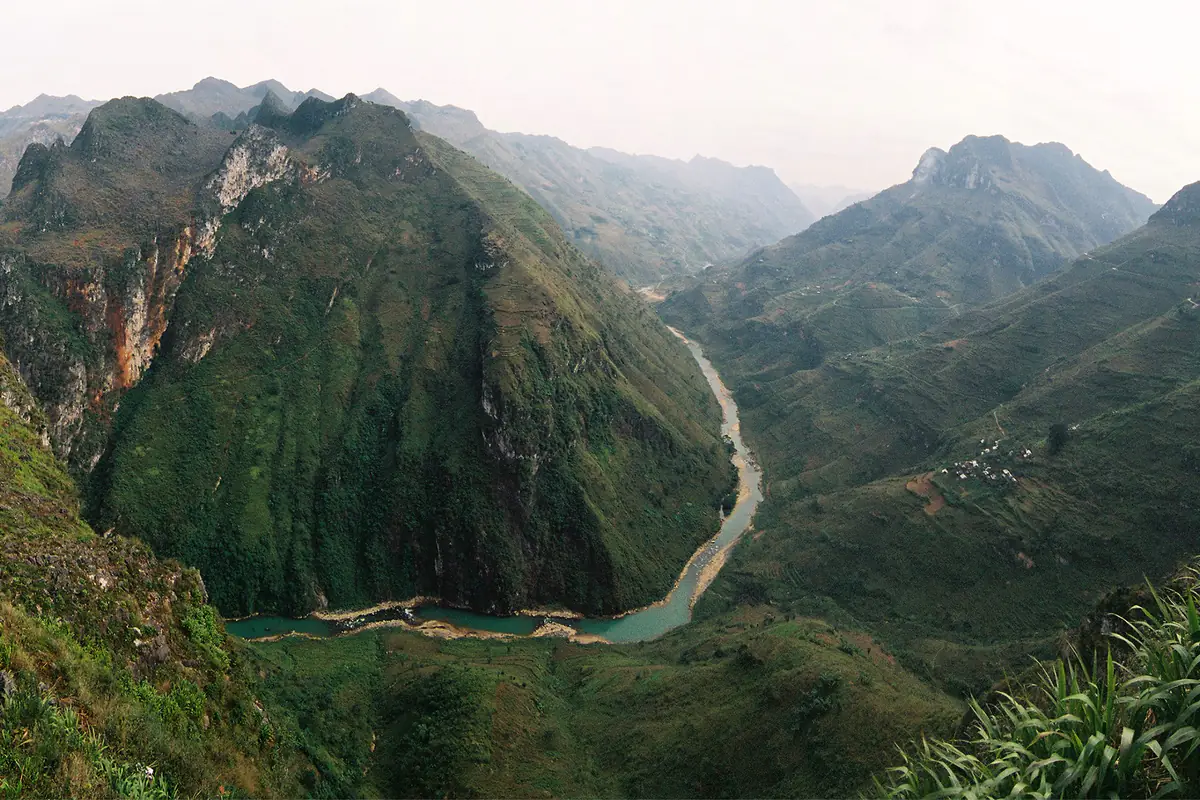
A four-day, three-night Ha Giang Loop can still include these places, with overnight stops in Yen Minh, Dong Van, and Meo Vac or Du Gia.
However, that becomes a general Ha Giang Loop itinerary with some flower viewing, rather than a dedicated trip for the buckwheat season.
To make it work, you need to drop a few attractions.
Skip the Pho Bang detour, limit time at similar flower gardens, and decide whether Lung Cu or a boat excursion on the Nho Que River matters more to you.
Do not combine both itineraries and try to compensate by traveling faster.
With four days available, reduce the number of stops rather than the time you need to rest.
Do Ha Giang's buckwheat flower gardens charge an entrance fee?
Some gardens charge visitors for entry and photography, while other flowering fields are working agricultural plots that are not open to the public.
Some gardens around Dong Van charge about VND 10,000 per person, but that is not an official entrance fee applied to every buckwheat field in Ha Giang.
Other gardens may set their own prices or visitor arrangements.
Before entering, check for a price sign or ask the person managing the field.
It is also important to distinguish a tourism-oriented flower garden from a farmer's crop.
Some buckwheat fields are grown for seeds and agricultural use, rather than for visitors to walk through.
How do you choose a good flower garden?
Look for three things: healthy blossoms, a clear walking path, and an attractive background.
The largest garden is not always the best place for photographs.
A smaller field in Sung La, with an earthen house and limestone mountains behind it, may offer more interesting compositions than a huge garden filled with flowers but little surrounding scenery.
Before paying to enter, take a moment to look at the plants.
If most of them have darkened, developed seeds, and have few fresh blossoms remaining, you may prefer another garden.
Where gardens have marked walking paths, stay on them.
This protects the plants and helps keep the fields attractive for people visiting later in the season.
What time of day is best for photographing buckwheat flowers?
Around 7:30-10:00 AM and 3:00-4:30 PM are generally useful windows for outdoor flower photography when the weather is favorable.
In the morning, the light can be softer, especially where mountains partially block the sun.
However, the Dong Van Karst Plateau has many valleys surrounded by steep slopes. Not every field receives sunlight at the same time.
In the afternoon, lower-angle sunlight can bring out the texture of mountains, houses, and delicate flower petals.
Some valleys, though, fall into shadow early because of the surrounding peaks.
On Day 2 of the suggested itinerary, visit Sung La in the morning.
On Day 3, focus on Lung Cu, where the villages and mountain scenery provide additional subjects alongside the flowers.
Wide landscapes or close-up portraits?
Buckwheat blossoms are small.
In wide landscape photographs, the fields usually appear as patches of white, pink, or soft purple mixed with green leaves.
Do not expect every location to look like an uninterrupted carpet of bright pink flowers.
To make the flowers more prominent, move closer and frame a cluster of blossoms against limestone mountains or a traditional earthen house.
For portraits, standing beside a flower bed on an existing walking path is often better than entering the middle of the field.
It also helps protect the crops.
Take a few wider shots as well.
Ha Giang's buckwheat flowers are at their most distinctive when photographed as part of the plateau, with gray mountains, stone fences, and small village houses in the background.
What should you wear for flower photography?
White, cream, dark blue, and muted colors generally stand out well against pale pink flowers and gray limestone.
Whatever you choose for photographs, bring a warm outer layer.
Early mornings and evenings in Dong Van and Lung Cu can be cold, while midday may feel noticeably warmer in direct sunlight.
Comfortable walking shoes matter more than fashionable footwear.
Paths around agricultural fields may be made of soil, loose stones, or uneven steps.
If you bring another pair of shoes for photographs, change into them on stable ground rather than trying to walk along narrow field edges in unsuitable footwear.
Should you visit on a weekday or weekend?
A weekday is generally better if your main goals are flower viewing and taking photographs without large crowds.
Ha Giang's buckwheat season coincides with a popular period for travel to the northern highlands.
Places such as Tham Ma Pass, the House of Pao, central Dong Van, and Lung Cu can become particularly busy on weekends.
Crowds can mean spending more time waiting for photographs or finding a suitable place to stop.
A location that normally takes 30 minutes may require much longer when there are many visitors.
If your schedule is flexible, arrange Days 2 and 3 of the itinerary to fall on weekdays.
Those are the two main flower-viewing days, covering Sung La and Lung Cu.
There is one reason to choose a weekend: the Dong Van Sunday Market.
The market is an important place for local trade and community life, and it can be an interesting addition for travelers who want to learn more about the region.
However, visiting the market also takes time.
If you want to go on Sunday morning, replace a flower stop with the market rather than adding it to an already full day.
What should you check before leaving for Ha Giang?
Do not rely only on the weather forecast for central Ha Giang.
Higher areas such as Dong Van and Lung Cu may experience different conditions, particularly in the early morning.
For a flower-focused trip, there are three things worth confirming.
First, check where the flowers are currently blooming
Contact your accommodation in Dong Van or the person organizing your trip.
Ask specifically about Sung La, Sa Phin, and Lung Cu.
Instead of asking only whether buckwheat flowers are in season, ask which gardens are currently blooming, whether they accept visitors, and where vehicles can stop.
These questions are more useful than a general confirmation that the flower season has started.
Second, check the weather for your two main flower days
If one day looks particularly cloudy or rainy, you may be able to adjust the order of nearby stops.
Do not reorganize the entire journey simply to chase a patch of sunshine at a distant location.
The advantage of staying two nights in Dong Van is that you have some flexibility without changing your overnight arrangements.
Third, confirm your accommodation in Dong Van
Staying in the same place for two nights removes the need to pack your luggage between the Sung La and Lung Cu excursions.
Confirm the check-in date, the number of nights, and where your vehicle can stop or collect you, especially during the festival period.
For international visitors, common English search terms include Ha Giang Buckwheat Flower Season, Dong Van Buckwheat Flower Festival, Sung La Valley, and Lung Cu.
Although the region now falls administratively within Tuyen Quang Province, many travel platforms continue to use Ha Giang for the famous mountain route and its surrounding attractions.
Road conditions, driving licenses, and transport choices should be prepared using a separate Ha Giang Loop guide.
For this flower-focused itinerary, the main rule is simple: keep each day to one or two principal flower-viewing areas.
What if you have only 3 days or can stay for 5?
Four days offer a comfortable balance for seeing buckwheat flowers from central Ha Giang.
However, the route can be adjusted if you have less or more time.
If you only have 3 days
Consider spending two nights in Dong Van, or one night in Yen Minh and one in Dong Van, depending on when you reach Ha Giang.
Prioritize Sung La and Sa Phin on the way north, then allow some time for Dong Van itself.
Add Lung Cu only if your actual schedule permits.
You do not need to include Meo Vac.
Cutting longer detours will leave you with more time to enjoy the flowers instead of spending most of your trip in transit.
Three days are not enough for a relaxed visit to Sung La, Pho Bang, Lung Cu, Ma Pi Leng Pass, the Nho Que River, and Du Gia all together.
Choose the places that matter most and leave the others for another journey.
If you have 5 days
Add a night in Meo Vac or Du Gia.
After spending two days around Dong Van and Lung Cu, continue toward Ma Pi Leng Pass and choose an activity around the Nho Que River that fits your schedule.
Then stay overnight in Meo Vac or continue toward Du Gia according to a route you have already checked.
Return to Ha Giang on the final day.
This version works well for travelers who want both buckwheat flower photography and some of the dramatic mountain scenery that makes the Ha Giang Loop famous.
An extra day also provides room to adjust your plans if the weather is poor for part of the trip.
Open your map and save Sung La, Sa Phin, and Lung Cu, then look for accommodation in Dong Van for two consecutive nights. Before booking, message the property and ask which nearby buckwheat fields are expected to be in the best condition during your stay.
FAQ
What month is best for buckwheat flowers in Ha Giang?
Late October to mid-November is generally the best period to visit. Flowers can begin blooming in early October, while fields planted later may remain attractive into December. For 2026, local authorities arranged three planting phases to extend the season from October through December, but the best flowering dates still vary between locations.
Where are the best places to see buckwheat flowers in Ha Giang?
Sung La, Lung Cam Village, Sa Phin, and Lung Cu are among the areas worth prioritizing. Sung La is particularly good for photographing flowers alongside traditional houses and valley scenery. Lung Cu offers mountain villages, limestone landscapes, and several locations designated for buckwheat cultivation. With four days, spend one day around Sung La and Sa Phin and another around Lung Cu.
When is the Dong Van buckwheat flower festival in 2026?
The 12th Buckwheat Flower Festival officially opened at 8:00 PM on October 25, 2026, at Thanh Nien Square in Dong Van, Tuyen Quang Province. November 6 appeared in the original schedule, but the opening ceremony was moved to October 25. Related seasonal activities continue through the end of December 2026.
Are buckwheat flowers blooming in Ha Giang right now?
Yes, the buckwheat flower season is underway. Fields around Pho Bang and Lung Cu were already flowering in October, and the season continues into November. However, individual fields bloom at different times. Before visiting, check recent photographs or ask your accommodation which gardens currently have the best flowers.
How many days do you need to see Ha Giang's buckwheat flowers comfortably?
Four days and three nights, starting from central Ha Giang, are a good choice. Spending one night in Yen Minh and two in Dong Van allows time for Sung La, Sa Phin, and Lung Cu without rushing. If you also want to visit Ma Pi Leng Pass, Meo Vac, the Nho Que River, and Du Gia, plan for five days or remove some flower stops from the route.