Meteor showers in Vietnam 2026: pick the best night to see shooting stars
The Geminids meteor shower in December is the best remaining opportunity to watch shooting stars in Vietnam in 2026. December 13-14 and 14-15 are both worth considering, but you will need clear weather, a dark location, and enough time to watch.
By Da Lat LoversPublished Updated
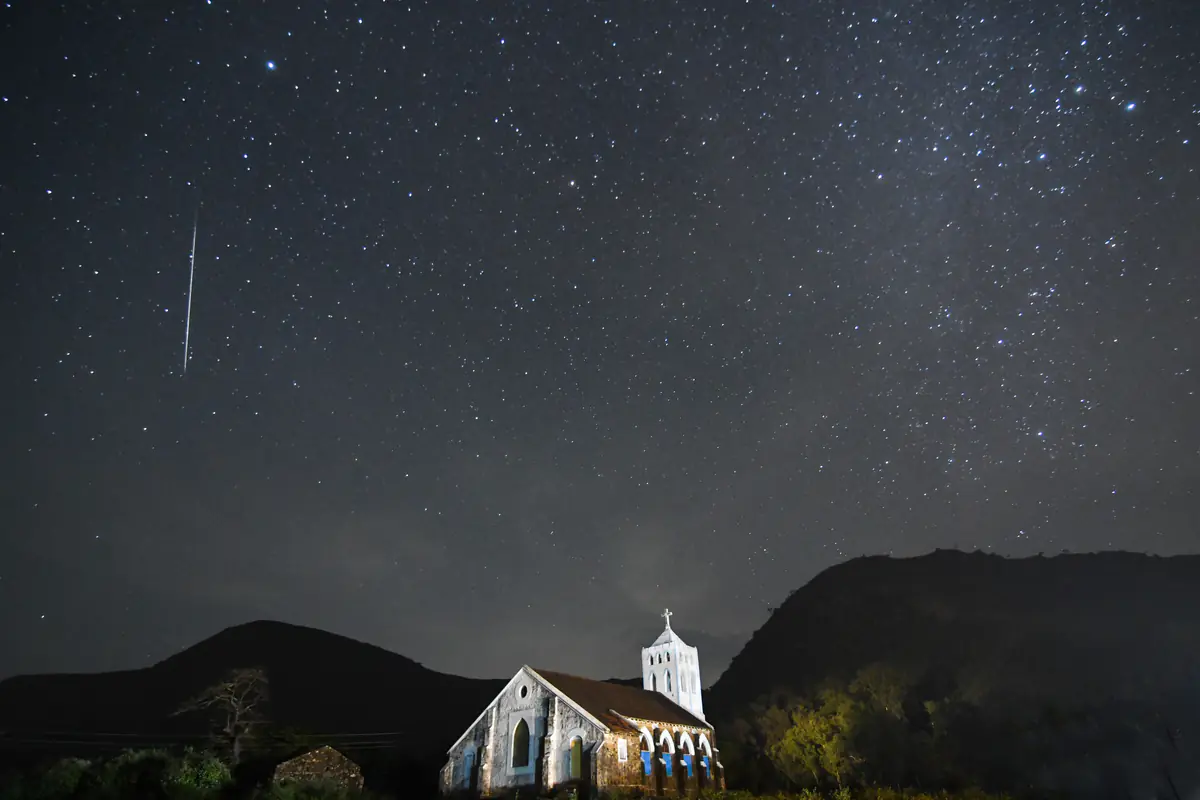
A bright Geminid streaks across the starry sky above a church in Sunkarametta, India.
Watching the sky from a brightly lit rooftop in central Hanoi at 10 PM is very different from sitting in a quiet rural courtyard with the lights switched off. On the same night, the first location might reveal only the brightest meteors, while the second gives you a much better chance of seeing faint streaks. Meteor showers are visible from Vietnam, and you do not need special equipment to enjoy them. The important things are choosing the right night, finding clear skies, and staying away from strong artificial lighting.
Can you see meteor showers in Vietnam?
Yes. Vietnam is well positioned to observe several annual meteor showers, including the Geminids in December, Perseids in August, Leonids in November, and a number of smaller showers throughout the year.
You do not need to visit an observatory, climb a mountain, or bring a telescope. A quiet outdoor area with a clear view of the sky can be enough.
Meteor showers happen when Earth passes through streams of small particles left behind by comets or asteroids. As these particles enter our atmosphere at high speeds, they produce the bright streaks commonly called shooting stars.
Despite the name, they are not actual stars falling toward Earth.
And unlike fireworks, meteors do not appear on a fixed schedule. You might watch an empty patch of sky for several minutes, then suddenly see two bright streaks within a short interval.
You can observe meteor showers from Hanoi, Da Nang, Da Lat, Ho Chi Minh City, and many other parts of Vietnam. What changes from place to place is how many meteors are visible.
The biggest factors are light pollution, cloud cover, moonlight, and the position of the meteor shower's radiant.
The radiant is the point in the sky from which meteors belonging to a particular shower appear to originate. It is not where every meteor will appear, but its altitude affects how many meteors an observer can potentially see.
Vietnam is particularly suitable for watching the Geminids because their radiant rises high during the night. The Perseids are also visible, although northern Vietnam generally has a more favorable viewing angle than the far south.
Meteor shower calendar 2026: which nights are worth watching?
The Geminids are the strongest major meteor shower still to come in 2026.
There are other opportunities in November and December, but not all justify a long journey or an overnight trip.
| Meteor shower | Dates to consider in Vietnam | Ideal peak ZHR | Recommendation |
|---|---|---|---|
| Northern Taurids | November 11-12, 2026 | Around 5 | Watch if convenient |
| Leonids | Early mornings of November 17-18, 2026 | Around 15 | Worth trying under clear skies |
| Geminids | December 13-15, 2026 | Around 150 | Best remaining choice |
| Ursids | Around December 22, 2026 | Around 10 | Lower priority because of moonlight |
ZHR stands for Zenithal Hourly Rate. It describes the theoretical number of meteors per hour under ideal conditions, with a very dark sky and the radiant directly overhead. It does not represent the number you are guaranteed to see.
Leonids in November: worth a look, but keep expectations reasonable
The Leonids are active from November 6 to 30, 2026.
The best time is the early morning hours of November 17 and 18, after the Moon has set.
In Vietnam, roughly 2 AM to 5 AM is a practical viewing window. By then, the constellation Leo, where the Leonids appear to originate, has risen above the horizon.
The Leonids are famous for producing spectacular meteor storms in certain years. Some historical events involved unusually high numbers of meteors.
That does not mean a similar display is expected in 2026.
Under ideal conditions, the usual rate is around 15 meteors per hour, and most people will see fewer.
If you already have access to a dark outdoor location, the Leonids are worth trying. But I would not plan an expensive overnight trip specifically for this year's shower.
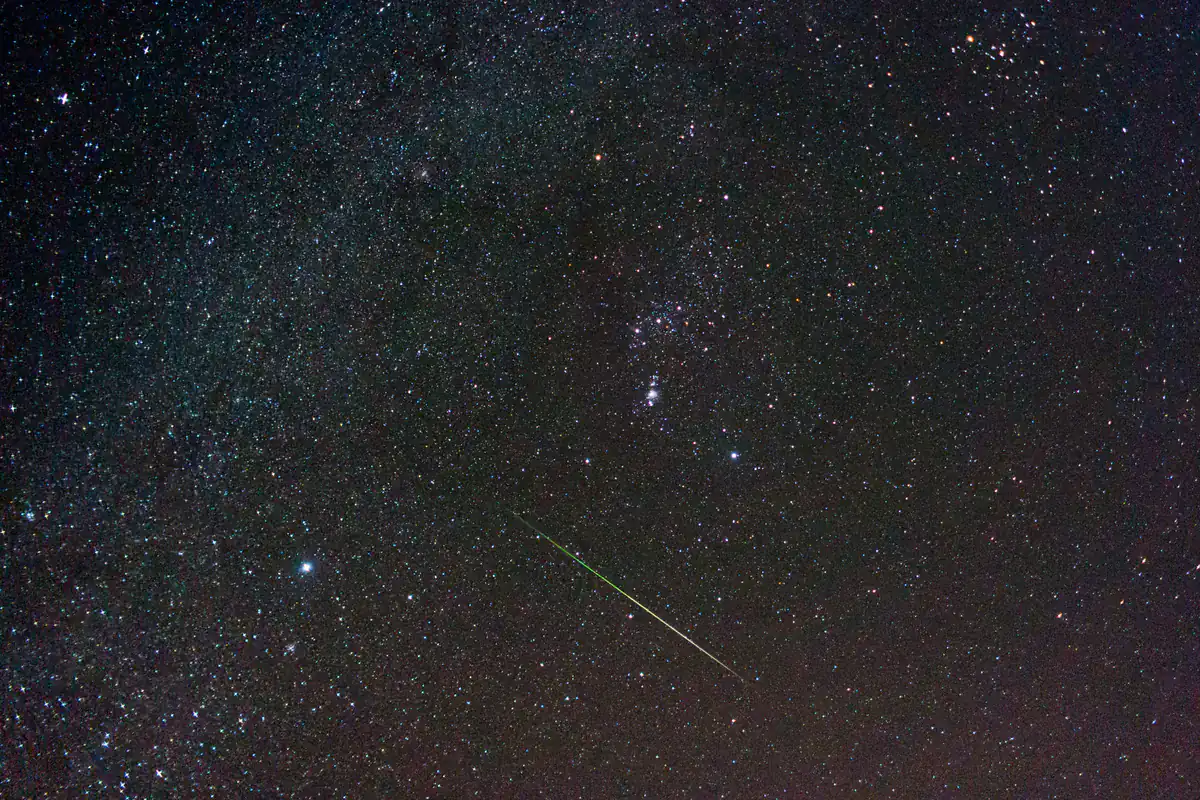
Geminids in December: the main event
The Geminids are among the strongest and most reliable annual meteor showers.
In 2026, the theoretical maximum ZHR is approximately 150.
The timing is favorable because the Moon will be a waxing crescent during the peak period. It will set during the evening, leaving much of the night relatively free from moonlight.
Another advantage is that the Geminids can produce good activity before midnight. You do not have to stay awake until 4 AM to have a worthwhile experience.
Ursids in late December: usually not the best choice
The Ursids are another December meteor shower, but they are considerably weaker than the Geminids.
Their 2026 maximum falls close to the full Moon on December 24, creating unfavorable viewing conditions for faint meteors.
If you can only choose one December meteor shower, prioritize the Geminids.
When is the Geminids meteor shower in December 2026?
This is where international meteor shower calendars can be confusing.
Many general skywatching calendars list December 13-14, 2026 as the Geminids' peak night.
However, the detailed forecast from the International Meteor Organization (IMO) puts the center of maximum activity at 14:00 UTC on December 14.
In Vietnam, which uses UTC+7, that is:
9:00 PM on Monday, December 14, 2026.
These dates are not necessarily contradictory.
Well-observed Geminid maxima over the past two decades, mapped onto the 2026 calendar, fall between 21:00 UTC on December 13 and 18:00 UTC on December 14.
Converted into Vietnam time, that means approximately 4:00 AM on December 14 through 1:00 AM on December 15.
Should you watch on December 13 or December 14?
Night of December 14 into December 15: This is the preferred option if you want to observe near the predicted maximum. Start around 9:30-10 PM and continue into the early morning if conditions remain good.
Night of December 13 into December 14: Also an excellent option. The hours before sunrise on December 14 fall within the wider historical maximum window. This is worth choosing if the weather forecast is better than on the following night.
Night of December 12 into December 13: You may still see Geminids, but activity will generally be further from the predicted maximum.
The best approach is to keep both December 13 and 14 available until the weather forecast becomes more reliable.
A clear sky on December 13 will usually give you a better viewing experience than a completely overcast sky on December 14, regardless of which night is closer to the predicted peak.
Will moonlight be a problem in 2026?
Not much.
The Moon will be a relatively thin waxing crescent around the Geminids maximum. It should set during the evening in Vietnam.
In Hanoi, for example, the Moon sets around 9:42 PM on December 14. Exact times vary depending on location.
Once the Moon has set, the sky will become darker, making faint meteors easier to notice.
This makes the 2026 Geminids considerably more attractive than a meteor shower occurring under a bright full Moon.
What time is best to watch the Geminids in Vietnam?
For most people, 10 PM to 3 AM is a sensible viewing window during the 2026 Geminids.
If you can spare only two hours, try 11 PM to 1 AM.
There is no guaranteed meteor count for any particular hour, but you can organize the night around the changing position of Gemini and the amount of moonlight.
8 PM to 10 PM: good for families and early viewers
After sunset, Gemini begins climbing in the eastern sky.
The radiant is relatively low earlier in the evening, so fewer shower meteors may be visible than later in the night.
However, you can still spot bright meteors.
This is the most convenient period for families with children or anyone who cannot stay out very late.
On December 14, waiting until around 9:30 PM or later will also help reduce interference from the setting crescent Moon.
You do not need to remain outside until dawn to enjoy the shower.
10 PM to 1 AM: the most practical window
By this time, Gemini has climbed higher, and moonlight should no longer be a major issue.
At a dark location, this is a useful period for continuous observation.
Plan for at least 60-90 minutes.
If you step outside for five minutes, see nothing, and return indoors, you may simply have missed the next bright meteor.
1 AM to 4 AM: for more dedicated observers
The Geminids radiant reaches its highest point at approximately 2 AM local time.
That means the geometry of the shower becomes particularly favorable during the hours around this point.
However, on the morning of December 15, the shower will already be several hours past the predicted central maximum.
Meteor activity does not necessarily keep increasing until dawn.
This period is best for people who have arranged comfortable seating, warm clothing, and somewhere to rest afterward.
Avoid planning a long motorcycle ride or drive immediately after an entire night without sleep.
Which direction should you look for the Geminids?
The Geminids radiant is located in the constellation Gemini, near the bright stars Castor and Pollux.
From Vietnam in mid-December, its approximate position changes throughout the night.
| Local time | Approximate location of Gemini |
|---|---|
| 8-10 PM | Eastern to northeastern sky, rising |
| 11 PM-1 AM | High in the sky |
| 1-3 AM | Very high, near its highest point |
| After 3 AM | Moving toward the western half of the sky |
These directions are general guidance. Exact positions vary by city, date, and time.
Do you need to look directly at Gemini?
No.
This is one of the most common mistakes people make when watching meteor showers.
The radiant is simply the point from which the meteors appear to spread outward.
Individual meteors can streak across many different parts of the sky.
In fact, meteors appearing farther from the radiant often leave longer visible trails, while those close to the radiant may look shorter.
Find Gemini if you want to understand the shower's direction, then look toward a wide, dark area of sky away from strong lights.
Lying back and looking toward the upper part of the sky is often more comfortable than keeping your head pointed in one direction.
How can you find Gemini without knowing astronomy?
Use a sky-map application such as Stellarium.
Set the observing location to your actual city in Vietnam.
Choose December 14, 2026, and adjust the clock to 10 PM or midnight.
Search for Gemini, Castor, or Pollux.
The app will show where the constellation should appear relative to your position.
Once you have found it, lower your phone's brightness and put it away.
Repeatedly checking a bright screen makes it harder for your eyes to adapt to the darkness.
Where to watch meteor showers in Vietnam
The best meteor shower location is not necessarily the highest mountain or most famous viewpoint.
You need three things: low light pollution, an unobstructed view of the sky, and safe nighttime access.
A hotel courtyard in a rural area with its lights switched off might be better than a mountain campsite surrounded by bright decorative lighting.
Hanoi and northern Vietnam: look beyond the city lights
Central Hanoi has considerable light pollution.
Streetlights, office buildings, apartment towers, and commercial areas brighten the night sky, making faint meteors difficult to see.
You may still catch the brightest Geminids from a rooftop, but your chances improve considerably outside the city.
Rural areas around Ba Vi and Soc Son are reasonable places to begin looking for accommodation with an open outdoor space.
They are only a starting point; the actual spot depends on each property.
Before booking, ask whether the property has a courtyard, terrace, or designated outdoor area that guests can use after 10 PM.
Do not assume that every hill, field, or forest road is accessible at night.
Northern Vietnam can also be cool, misty, and cloudy during December.
Even if rain is unlikely, low clouds and fog can block the stars.
Check conditions carefully before making a long trip.
Ho Chi Minh City and southern Vietnam: better seasonal weather prospects
December is generally part of southern Vietnam's dry season.
That does not guarantee clear skies every night, but it can make outdoor planning easier than during the wetter months.
From Ho Chi Minh City, you could look for rural accommodation in Dong Nai or around Vung Tau.
Less populated parts of the former Binh Thuan area are another option worth researching.
The goal is not to reach a particular tourist attraction. You want a legal, accessible place with limited surrounding light.
Do not judge a location by distance from the city alone.
Industrial facilities, ports, resort developments, and large residential areas can produce significant light pollution even outside major urban centers.
Coastal locations may have wide views, but fishing boats, beachfront restaurants, and resort lighting can brighten the sky.
A quiet property with a dark courtyard is often a more reliable choice than driving to an unfamiliar beach at midnight.
Central Vietnam: check December cloud cover first
Hue, Da Nang, and Hoi An can experience substantial rain and cloud cover in December.
For these destinations, weather should be your first consideration.
There is little point traveling an hour outside Da Nang if a thick layer of cloud covers the entire region.
Farther south, rural areas around Phan Rang and less populated parts of south-central Vietnam may offer better opportunities on suitable nights.
Look for established campsites, licensed accommodation, or privately managed properties where nighttime access is allowed.
Avoid choosing isolated stretches of coast, forest tracks, or unfamiliar mountain roads simply because they look dark on a map.
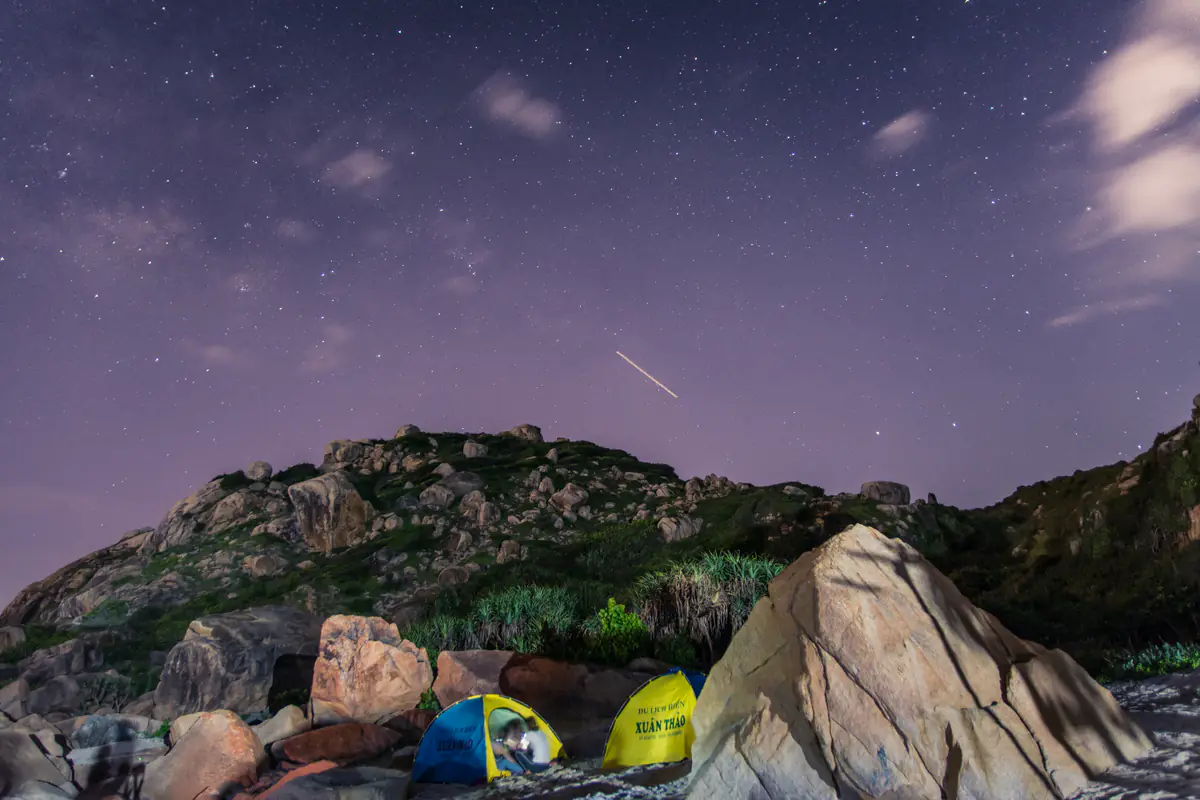
Da Lat: a short stargazing option
In Da Lat, you can consider a stargazing location or homestay on the outskirts of the city, away from the brightest central neighborhoods.
Ask whether the outdoor space is available late at night and whether surrounding lights can be reduced.
In Da Lat, lit greenhouses also brighten the night sky. A low, open courtyard can be better than a hilltop surrounded by bright greenhouse lighting.
On December 14, the Moon sets around 9:45 PM in Da Lat, so from about 10 PM the sky is darker for watching.
December can bring clear nights, but clouds and fog remain possible.
There is no reason to enter an isolated pine forest or follow an unfamiliar dirt road after dark just to escape city lights.
In December the average low in Da Lat is about 15°C, and sitting still for two hours can feel considerably colder than walking around.
How to find a dark-sky location without traveling too far
Before choosing a destination, open Light Pollution Map.
This website displays information about artificial nighttime lighting and estimated sky brightness.
It is useful for comparing areas around cities and identifying places where the sky may be darker.
A practical way to use it is:
- Locate your current city and decide how far you are willing to travel.
- Look for areas with lower levels of light pollution.
- Switch to a satellite map to examine roads, buildings, and terrain.
- Find accommodation or a managed outdoor location in that area.
- Check weather forecasts for the specific location rather than the nearest major city.
Treat the light pollution map as a planning tool, not a guarantee.
Satellite data may not show recently installed lights, temporary floodlights, or the exact brightness experienced at ground level.
Clouds, humidity, and fog can also make urban light pollution more noticeable.
When you arrive, take a look around before setting up.
A bright white lamp shining directly toward your chair will interfere with your vision.
Moving to a safe corner where the lamp is blocked by a wall may improve conditions.
You do not necessarily need the highest viewpoint.
A low, open courtyard under a clear sky can be better than a hilltop covered in cloud.
How to check the weather before going meteor watching
Weather can ruin an otherwise perfectly planned meteor shower trip.
A thick cloud layer will block meteors regardless of how strong the shower is.
Mist, drizzle, and high humidity can also reduce visibility.
Check conditions at three different stages.
Two or three days before
Look at the general forecast to decide whether traveling is worthwhile.
Pay attention to rain probability, cloud cover, wind, and potentially dangerous weather.
Do not rely entirely on a single clear-night icon.
A forecast can change, especially in mountainous areas.
If you need accommodation, a flexible cancellation policy is useful.
On the afternoon of your planned visit
Check hourly cloud forecasts covering roughly 9 PM to 3 AM.
If the service provides separate forecasts for low, middle, and high clouds, look at those too.
No rain does not necessarily mean a clear sky.
A completely dry night can still have enough cloud cover to hide nearly every star.
Satellite images can help you understand whether large cloud systems are approaching your location.
One or two hours before leaving
Make the final decision.
Look at the actual sky, check the latest satellite imagery, and contact your accommodation if you are unsure about fog or cloud conditions.
A simple test is to see whether many stars are already visible.
If only the brightest stars appear through a thick haze, meteor viewing will probably be disappointing.
The peak date is not worth taking unnecessary risks.
What should you bring to watch a meteor shower?
The most useful items are those that help you remain comfortable outside for a long time.
You do not need expensive astronomy equipment.
A reclining chair or ground mat: Looking upward while standing can strain your neck. A reclining camping chair makes it easier to watch a large section of the sky.
Warm clothing: Particularly important in Da Lat, the northern highlands, and northern Vietnam in December. Sitting still for two hours can feel considerably colder than walking around.
Water and snacks: Choose simple food that does not require bright lights or elaborate preparation.
A dim red flashlight: Useful for finding belongings or walking around the viewing area. Use it only when necessary.
A power bank and offline map: Helpful when traveling to rural areas with weak mobile reception.
A small rubbish bag: Collect your waste and dispose of it properly afterward.
A camera and tripod are optional.
If your main goal is to see shooting stars, your eyes are enough.
Do you need a telescope?
No.
Telescopes show only a small portion of the sky.
Since meteors appear unexpectedly across a wide area, a telescope is usually the wrong tool for meteor watching.
Binoculars are not particularly useful either.
Your unaided eyes provide a much wider field of view and make it easier to notice sudden streaks of light.
How to watch the Geminids once you arrive
Suppose you are planning to watch the Geminids on the evening of December 14, 2026.
You could organize the night like this:
| Vietnam time | Suggested activity |
|---|---|
| 7:30-8:30 PM | Arrive, check the sky, arrange chairs and equipment |
| 8:30-9:00 PM | Reduce unnecessary lighting and allow your eyes to adjust |
| 9:00-10:00 PM | Begin watching a wide, unobstructed area of sky |
| 10:00 PM-midnight | Main observation session |
| Midnight-2:00 AM | Continue if the sky remains clear |
| After 2:00 AM | Finish or extend the session depending on comfort and transport |
This is a suggested schedule, not a prediction of when individual meteors will appear.
Allow your eyes to adapt to the dark
Give yourself approximately 20-30 minutes without looking at bright lights.
At first, you may notice only a few bright stars.
As your eyes adapt, fainter stars become more visible, and you have a better chance of noticing dim meteors.
Opening your phone at full brightness can undo some of that progress.
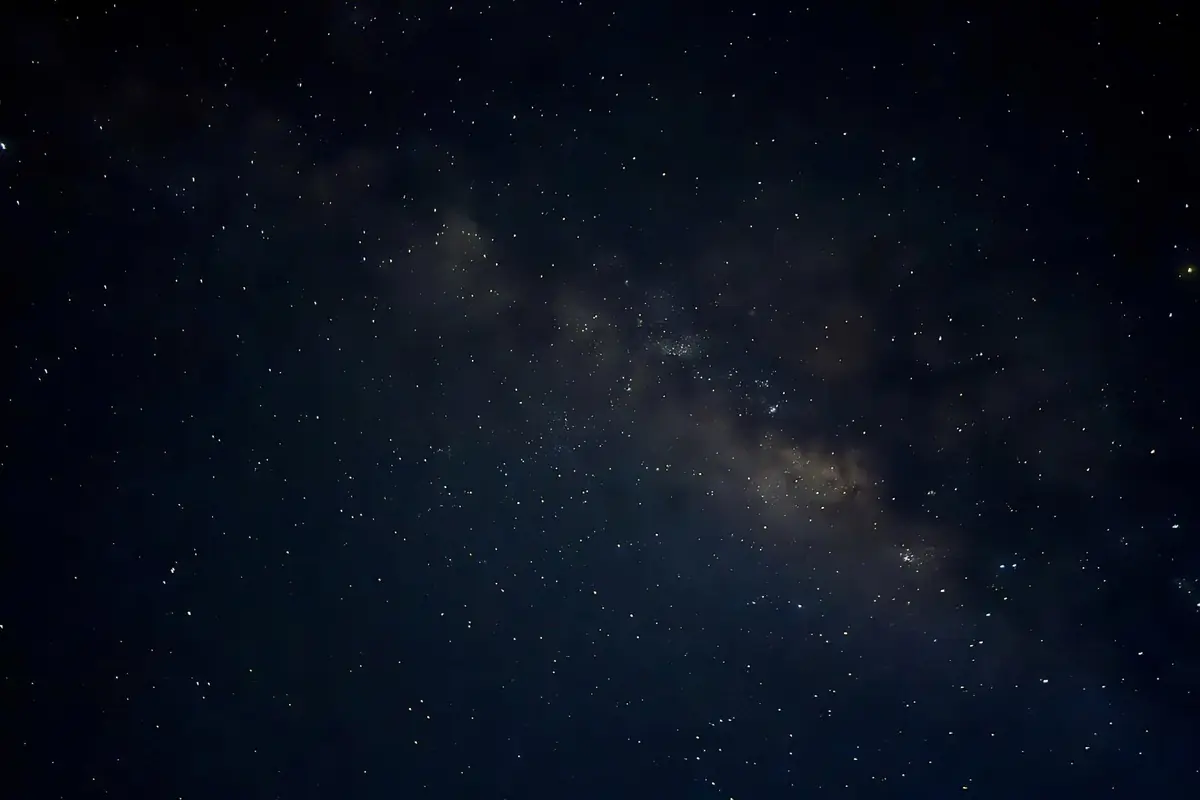
Use a dim red light when necessary and avoid staring at illuminated screens.
Watch a wide section of sky
Set up your chair so you can look comfortably toward a large open area.
You do not need to keep turning your head to find specific constellations.
A meteor may last less than a second, so the easiest method is simply to maintain a relaxed, wide view.
If clouds start covering one part of the sky, shift your attention to a clearer area.
Give it enough time
Even near maximum activity, meteors do not appear at evenly spaced intervals.
You might see nothing for ten minutes, followed by several streaks relatively close together.
Plan to stay for at least one hour.
People who want a more serious observation session can watch for two or three hours, taking short breaks when needed.
How many Geminids can you actually see per hour?
The often-quoted figure of 150 meteors per hour is the Geminids' theoretical maximum ZHR.
It is not a promise that you will count 150 shooting stars from your hotel balcony.
That rate assumes exceptionally favorable conditions, including a very dark sky, good visibility, and a radiant directly overhead.
A more realistic figure is approximately 40-50 Geminids per hour under favorable dark-sky conditions.
The number you see can be substantially lower.
Under bright city lights, you might notice only a handful of bright meteors during an entire session.
Thin clouds, haze, moonlight, nearby buildings, and the radiant's altitude also affect your count.
Meteor activity naturally varies throughout the night and between different years.
Not every meteor you see during the Geminids peak necessarily belongs to that shower.
There are also sporadic meteors, which are unrelated to the main stream.
One way to identify Geminids is to imagine extending their visible paths backward. Meteors belonging to this shower generally appear to trace back toward Gemini.
Colors are not a reliable identification method.
Geminids can appear white, yellow, greenish, or other colors, but you should not expect every meteor to look like the colorful streaks shown in promotional photographs.
Geminids vs Perseids: which meteor shower is better in Vietnam?
The Perseids and Geminids are often compared because both are major annual meteor showers.
For travelers in Vietnam, however, they offer different viewing conditions.
| Feature | Perseids | Geminids |
|---|---|---|
| Usual peak season | Mid-August | Mid-December |
| Parent object | Comet 109P/Swift-Tuttle | Asteroid 3200 Phaethon |
| Radiant constellation | Perseus | Gemini |
| Typical viewing hours | Better after midnight | Good activity can begin before midnight |
| Conditions in Vietnam | Rain and cloud cover can be common | Generally more favorable in southern Vietnam, but regional weather varies |
When did the Perseids peak in 2026?
The Perseids peaked around August 12-13, 2026.
That event has already passed.
The timing was favorable for a dark sky because the new Moon occurred on August 12.
Perseids are fast meteors that can produce bright streaks and sometimes persistent trails.
However, August is part of the rainy season in many parts of Vietnam.
A strong meteor shower does not help much when clouds cover the sky throughout the night.
Which should you choose?
For a future trip, compare the Moon phase, weather forecast, and your available observing hours.
Choose the Perseids when you have a clear August night and can stay awake until the early morning.
Choose the Geminids when you prefer a December trip and want a reasonable chance of seeing meteors before midnight.
For the remainder of 2026, the Geminids are the clear choice because the Perseids have already ended.
Can you photograph meteor showers with a smartphone?
Yes, but it is considerably harder than photographing a normal starry sky.
A smartphone may capture a particularly bright meteor if it happens to streak across the frame during an exposure.
However, most meteors appear without warning and disappear quickly.
A standard automatic night mode does not guarantee success.
If this is your first meteor shower, spend some time watching with your eyes rather than repeatedly checking your phone.
You may miss several shooting stars while looking down at the screen.
Recommended camera settings for meteor photography
A camera with manual exposure controls, a wide-angle lens, and a stable tripod offers more flexibility.
You can begin with these approximate settings:
- Wide-angle lens around 14-24 mm on a full-frame camera.
- Wide aperture, such as f/1.8 to f/2.8.
- ISO approximately 1600-6400, depending on the camera and sky brightness.
- Exposure times of around 10-20 seconds for initial tests.
- Manual focus on a bright star, checked using magnified live view.
- Continuous shooting with a tripod and interval timer.
These are starting points, not universal settings.
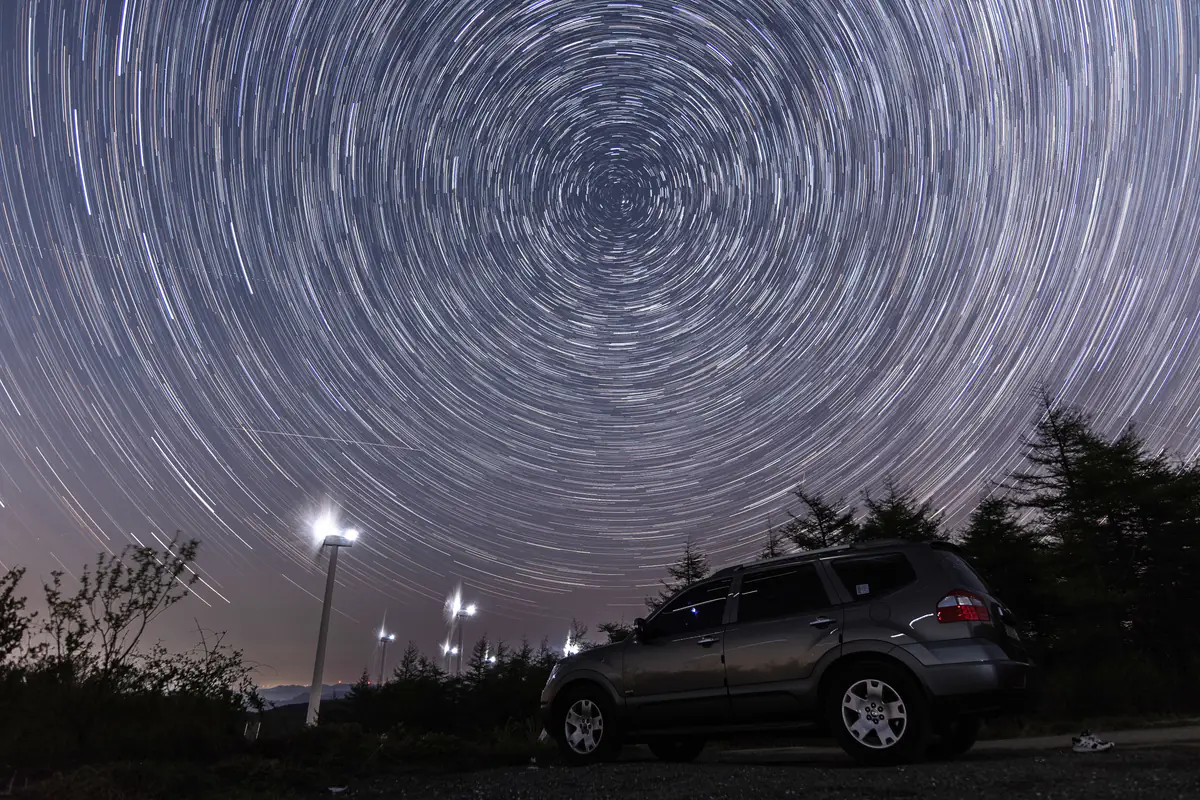
The best exposure depends on your lens, camera sensor, ambient light, and the appearance of the stars in test photographs.
Avoid using flash.
It will not help illuminate a meteor, and it can disturb other people watching nearby.
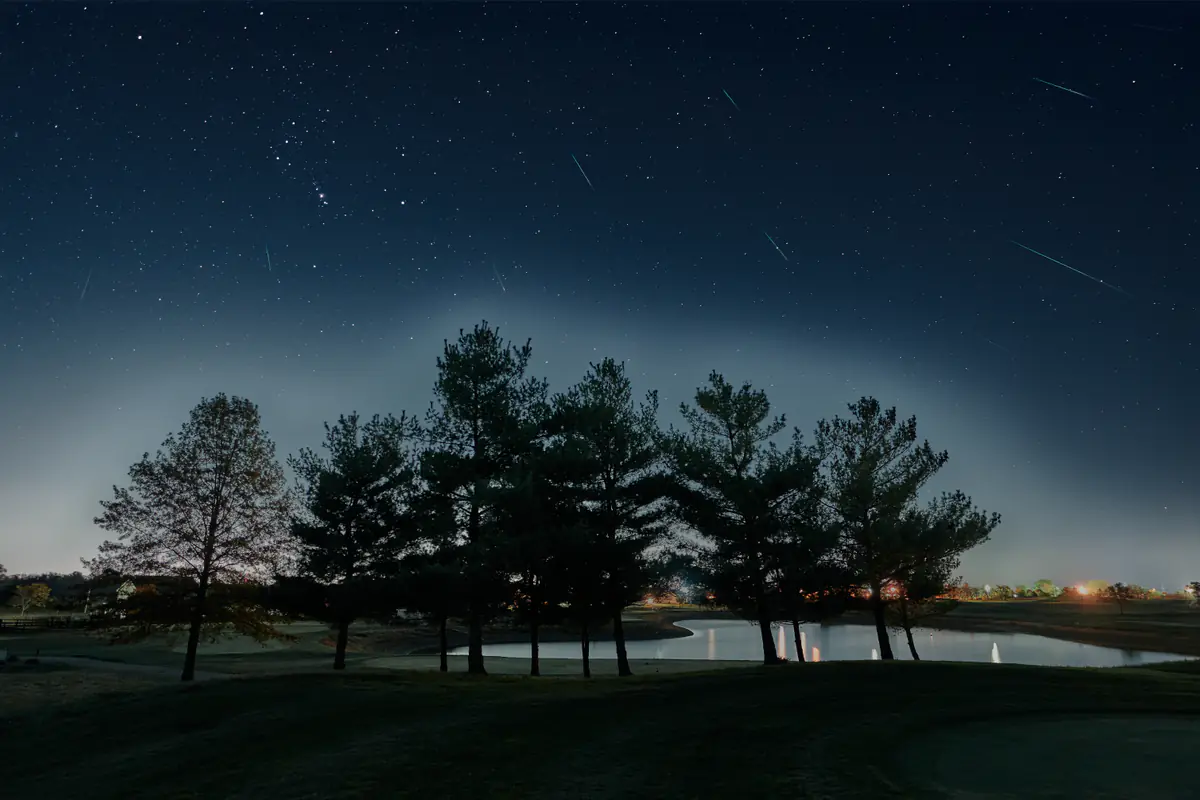
Also, remember that photographs showing dozens of meteor trails are often composites made from many separate exposures.
Do not expect a single 15-second photograph to reproduce that result.
Safety and access rules for nighttime meteor watching
Meteor watching is a normal outdoor activity. You do not need an astronomy permit simply to observe the sky from a place where public access is allowed.
However, private property rules, protected-area regulations, parking restrictions, and local access hours still apply.
A few precautions are worth taking.
Road access: Choose a route you can navigate safely after dark. Avoid unfamiliar forest tracks or mountain roads at night.
Parking: Use a designated or legally permitted parking area. Do not stop on narrow road shoulders, blind corners, or active traffic lanes.
Private land: Ask permission before entering private property. Do not climb fences or use a location after its official closing time.
Coastal and mountain locations: Stay away from cliff edges, slippery rocks, exposed coastal areas, and other hazards that become difficult to see at night.
Lighting and noise: Keep lighting low and avoid disturbing nearby residents or other skywatchers.
Driving after the session: Take a rest if you have been awake for most of the night.
If you are unfamiliar with mountain roads or do not hold the appropriate motorcycle license, using a car with a driver or staying overnight near the viewing location is a better option.
You do not need to turn a meteor shower into a risky overnight adventure.
Can foreign tourists watch meteor showers in Vietnam?
Yes.
Foreign visitors can observe meteor showers in Vietnam just like local residents, provided they use locations where access is permitted.
You do not need to join an organized astronomy tour.
A rural guesthouse or accommodation with a dark outdoor courtyard may be enough.
For international travelers, the main detail to remember is the time zone.
Vietnam uses Indochina Time (ICT), which is UTC+7 throughout the year.
There is no daylight saving time.
Many astronomy websites display their meteor shower calendars using the reader's selected city or local time zone.
Before making plans, confirm that the location is set to Hanoi, Ho Chi Minh City, Da Nang, Da Lat, or wherever you will actually be staying.
Useful English terms include:
| Term | Meaning |
|---|---|
| Meteor shower | An event when many meteors appear from one apparent radiant |
| Geminids meteor shower | The major annual shower peaking in December |
| Perseids meteor shower | The major annual shower peaking in August |
| Peak time | The predicted period of strongest activity |
| Radiant | The apparent origin point of a meteor shower |
| Light pollution | Artificial light that brightens the night sky |
| Dark-sky location | An area with relatively little artificial lighting |
| Meteor watching | Observing meteors, usually with the naked eye |
When choosing accommodation, ask a few practical questions before booking.
Can guests use the courtyard after 10 PM? Can outdoor lights be turned off or reduced? Is the property accessible by car at night? Is transportation available if you are not staying there?
A dedicated astronomy campsite can be useful, but it is not necessary.
What matters is having a comfortable, dark, and accessible place where you can remain outdoors for an extended period.
Common mistakes that make meteor showers harder to see
Using the wrong time zone: A peak date listed on an American website may refer to different local hours in Vietnam. Always check whether the source uses UTC or another time zone.
Ignoring cloud forecasts: A meteor calendar predicts shower activity, not the weather above your viewing location.
Standing under a streetlight: Strong artificial lighting reduces your ability to see faint meteors.
Using a telescope: Its narrow field of view is poorly suited to meteor watching.
Waiting for one exact peak minute: Meteor shower maxima extend over hours, and individual meteors cannot be predicted precisely.
Expecting 150 shooting stars every hour: ZHR is an idealized astronomical measurement rather than an actual guaranteed count.
Choosing an inaccessible location: A remote area is not automatically suitable. You still need safe roads, legal access, and somewhere comfortable to observe.
Giving up after ten minutes: Meteor activity is irregular. A short period without visible meteors does not necessarily mean the shower is over.
Which Geminids viewing plan should you choose?
There are three practical approaches, depending on how much time you have.
Option A: one evening without staying up too late
Choose a nearby dark location and start around 9:30-10 PM on December 14.
Watch for approximately one hour.
This is suitable for families, casual observers, and anyone who needs to work the next morning.
You may see fewer meteors than someone watching for four hours, but you will still be observing near a strong part of the shower.
Option B: a full night of meteor watching
Book accommodation with a dark courtyard or outdoor space.
Arrive before sunset and get some rest before your observation session.
Start around 10 PM and continue until 2-3 AM if the sky remains clear.
This gives you more time to see occasional bright meteors and avoids the need for a long drive immediately afterward.
Option C: keep two nights available
Reserve December 13 and 14 as possible viewing nights.
Check the cloud forecast close to the event and choose whichever night looks more promising.
Although the detailed forecast places the central maximum on the evening of December 14 in Vietnam, December 13-14 remains a strong observing period.
For someone whose main goal is to see shooting stars rather than simply visit on the official peak date, flexibility is valuable.
For the Geminids in 2026, mark December 14 at 9:00 PM as the predicted central maximum and consider watching from about 10 PM until 2 AM. A reclining chair, a clear view of the sky, and a place away from city lights are enough to give you a real chance of seeing shooting stars without a telescope.
FAQ
What time will the Geminids meteor shower peak in Vietnam in 2026?
The central maximum is predicted for 9:00 PM Vietnam time on December 14, 2026. For practical viewing, try 10 PM to 3 AM on the night of December 14-15. The previous night, December 13-14, is also a good choice.
Which direction should I look to see the Geminids in Vietnam?
The radiant is in the constellation Gemini, which rises in the eastern to northeastern sky during December evenings. It climbs high after midnight and reaches its highest point around 2 AM. You do not have to look directly at Gemini because meteors can appear across the sky.
Can I see meteor showers from Hanoi or Ho Chi Minh City?
Yes. Both cities are geographically suitable for observing the Geminids. However, artificial lighting makes faint meteors difficult to see in central neighborhoods. For better visibility, choose a dark location outside the city with a wide view of the sky.
Do I need a telescope to watch the December 2026 meteor shower?
No. Meteor showers are best observed with the naked eye. Choose a dark location, find a comfortable chair, avoid bright screens, and allow approximately 20-30 minutes for your eyes to adapt to the darkness.
Are the Perseids or Geminids better to watch in Vietnam?
Both can be excellent. The Perseids peak in August and often produce fast, bright meteors, but rainy-season cloud cover can interfere in Vietnam. The Geminids peak in December and are easier to watch during the late evening. In 2026, the remaining major opportunity is the Geminids because the Perseids have already passed.