Visit Linh Phuoc Pagoda in Da Lat: choose your route and plan your time
This guide is for travelers staying in Da Lat who want to see the mosaic pagoda at Trai Mat without using an entire day. It covers getting there, the main buildings, respectful dress and an easy afternoon route to Xom Leo.
By Da Lat LoversPublished Updated Đọc bằng tiếng Việt
Start with the right address and arrival time
Set your map to Linh Phuoc Pagoda, 120 Tu Phuoc Street, Trai Mat before leaving central Da Lat. The pagoda is about 8 km east of town, open from 7:00 am to 5:00 pm, and charges no entrance fee. Give yourself at least an hour if you want to see the mosaic dragon, main prayer hall and bell tower without rushing.
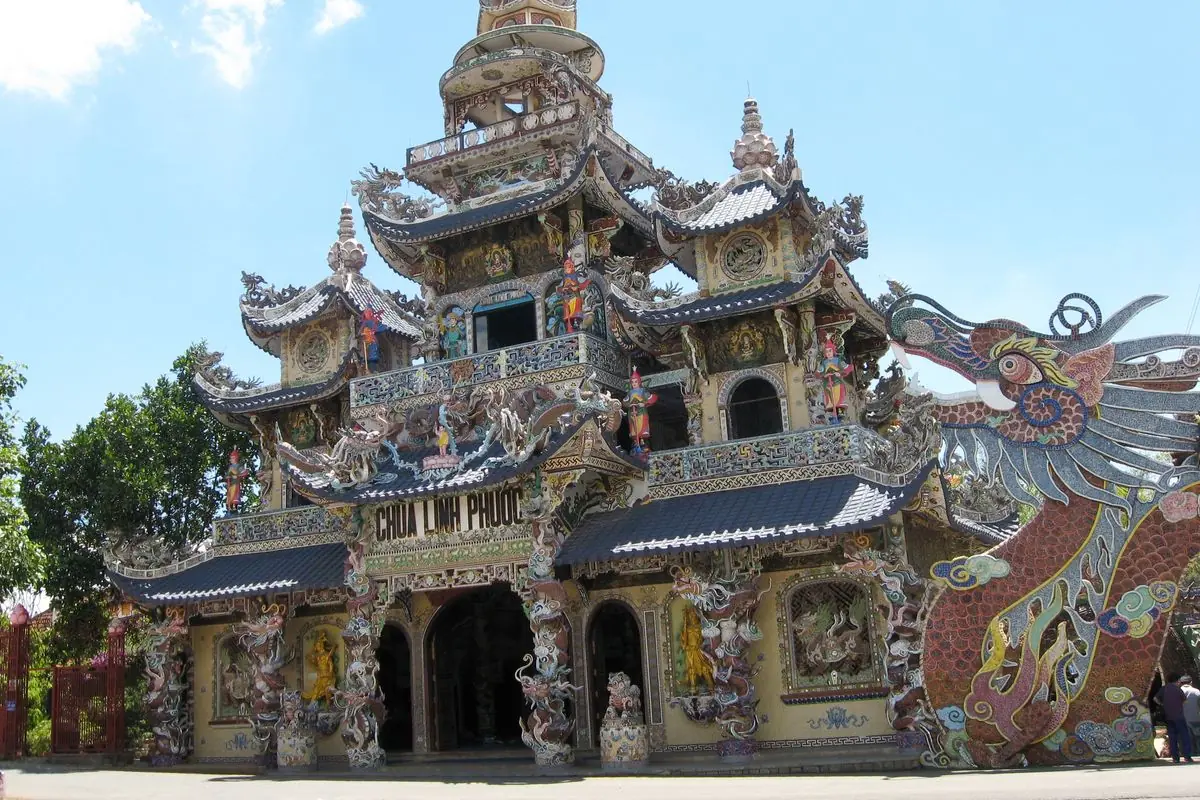
You may also see it called Chua Ve Chai, often translated as the Bottle Pagoda. The name comes from the thousands of pieces of bottles, ceramic tiles, pottery and glass worked into the buildings. These are not simply scattered decorations. Look closely and the fragments form dragon scales, flowers, roof details and Buddhist imagery across the complex.
Linh Phuoc is an active Buddhist place of worship as well as a well-known Da Lat attraction. You can come to admire the craftsmanship without taking part in prayers. You still need to dress and behave as a visitor to a temple, especially in the main hall. That distinction matters more than getting every photograph on a checklist.
How to get to Linh Phuoc Pagoda from Da Lat
By motorbike: best for a flexible half-day
From the Da Lat Market or Xuan Huong Lake area, head toward Tran Hung Dao Street, continue onto Hung Vuong Street and follow the main road toward Trai Mat. Turn toward Tu Phuoc Street for the final approach. Use the pagoda itself as your navigation destination; entering only “Trai Mat” can send you somewhere else in the neighborhood.
Allow roughly 20-30 minutes from the central tourist area, depending on your departure point and traffic. This is no short spin along a quiet village lane: expect cars, bends, slopes and local junctions. Slow down near the turn-off, particularly when the road is wet. Pull over safely to check a phone map; never look at the screen while riding.
A motorbike works well for travelers who plan to stop at the pagoda, explore Trai Mat and then continue east, or swing back to Xom Leo before sunset. You can adjust your departure time without worrying about a train ticket. You also carry the responsibility of riding legally. Use a motorbike only with the correct license recognized in Vietnam and appropriate cover; a license from your home country does not automatically qualify you to ride here. If you cannot ride legally, book a car or travel as a passenger with a suitable driver.
Follow the parking signs on arrival and park only where they allow. Ask about any local parking charge before leaving your vehicle. Keep the entrance and pedestrian route clear, particularly when tour groups are arriving.
By taxi or ride-hailing car: simplest for most visitors
Search “Linh Phuoc Pagoda” or enter 120 Tu Phuoc Street in your taxi or ride-hailing app. A car usually needs around 20-30 minutes from the main hotel areas, plus a little time for the final turn and drop-off. The amount you pay depends on the pickup point, traffic, time and type of car. Check the fare the operator shows before confirming; a price quoted in an old travel article will not match yours.
A car is a sensible choice for first-time visitors, families, older travelers and anyone uncomfortable with riding through Da Lat's hills. It removes the navigation work but not the walking inside the temple. The bell tower and some displays involve stairs, so plan the visit around the walking ability of your group.
For an afternoon with Xom Leo, save your next destination before entering the pagoda. A specific cafe or restaurant on Huynh Tan Phat Street is easier for a driver to find than the general name “Xom Leo”, which covers a whole area with no single ticketed entrance. If a driver offers a return trip with waiting time, agree on the waiting period, stops and final drop-off before accepting the price. Ride availability can be less predictable outside the busiest part of town after dark.
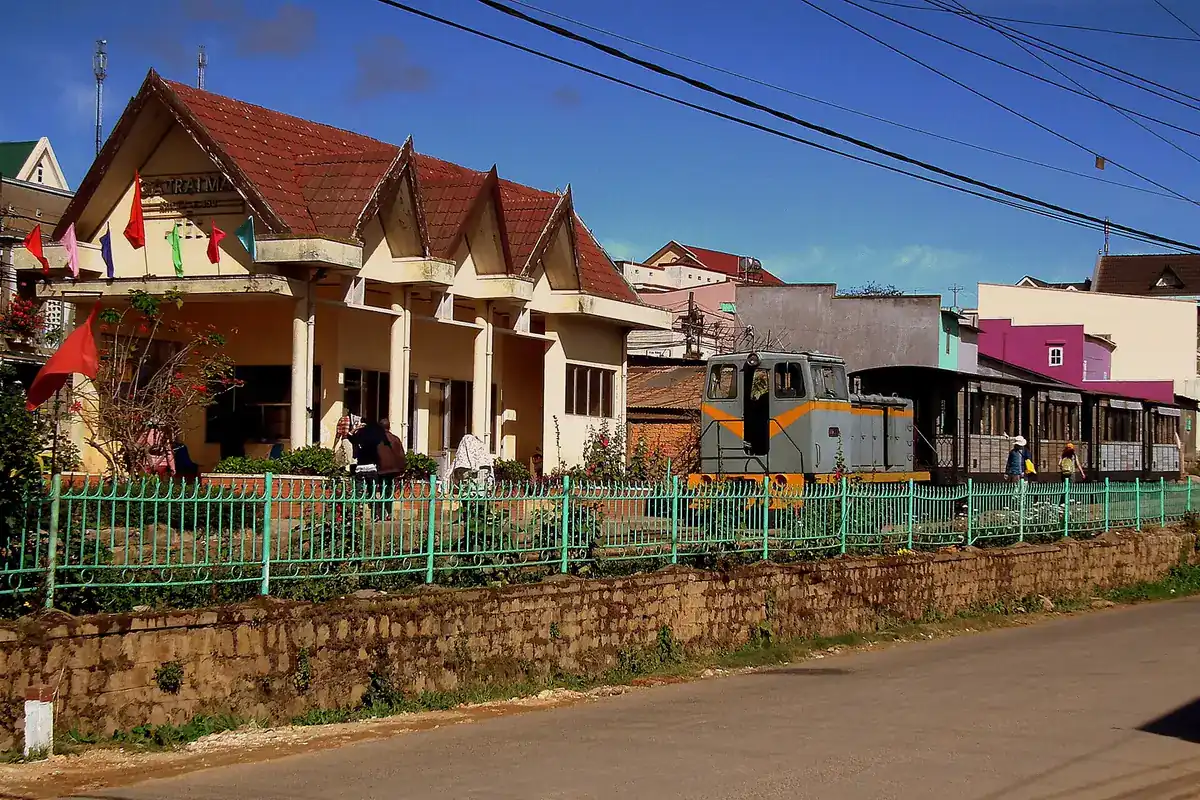
By the Da Lat to Trai Mat tourist train
Loading map...
- Linh Phuoc Pagoda: 120 Tu Phuoc Street, open 7:00 am-5:00 pm, free entry
- Trai Mat: tourist train stop, a short walk to the pagoda
- Da Lat Railway Station: 1 Quang Trung Street, about 30 minutes by train to Trai Mat
- Xom Leo: Huynh Tan Phat Street, valley views in late afternoon
- Da Lat Market: town center, 20-30 minutes by road to the pagoda
When is the best time to visit?
7:00-9:00 am is a good window if quiet surroundings are your priority. You have daylight to see the ceramic patterns, room in the schedule for the main hall and a comfortable margin before closing. Weekday mornings tend to be easier to manage than peak weekend and holiday periods. There may still be people worshipping or a group arriving early, so a peaceful visit is never guaranteed.
9:00-11:00 am also works for a morning outing. Have breakfast in town, then drive out. Once at the pagoda, begin with the dragon and main hall and save the long photo session at the gate for later. The exterior decoration is extensive; there will be more to see beyond the first ornate doorway.
1:30-3:30 pm is the most useful window if you want to combine the pagoda with Xom Leo. Spend an hour and a half at the temple, move on while it is still open, then reach the hillside viewing area in late afternoon. Xom Leo is known for its views across greenhouses and the valley as the light changes. Around 4:00-6:00 pm is a practical planning window, but actual sunset changes throughout the year and can disappear behind cloud or mist.
After 4:00 pm, do not build a two-hour pagoda itinerary. The pagoda closes at 5:00 pm and individual sections may stop admitting guests earlier. Take in the courtyard and any open prayer areas, then leave the deeper displays for another visit. Trying to fit all seven tower levels and the underground exhibition into the final hour defeats the point of coming here.
Bring a light layer and shoes with decent grip even on a clear morning. Da Lat's weather can shift during a single outing, and there are hard surfaces and stairs inside the complex. For travelers who come mainly for quiet worship, a morning visit gives you more space in the day and avoids an unnecessary rush to a sunset appointment.
What to see at Linh Phuoc Pagoda in one hour
Look at the facade before taking close-up photographs
About 10 minutes in the courtyard
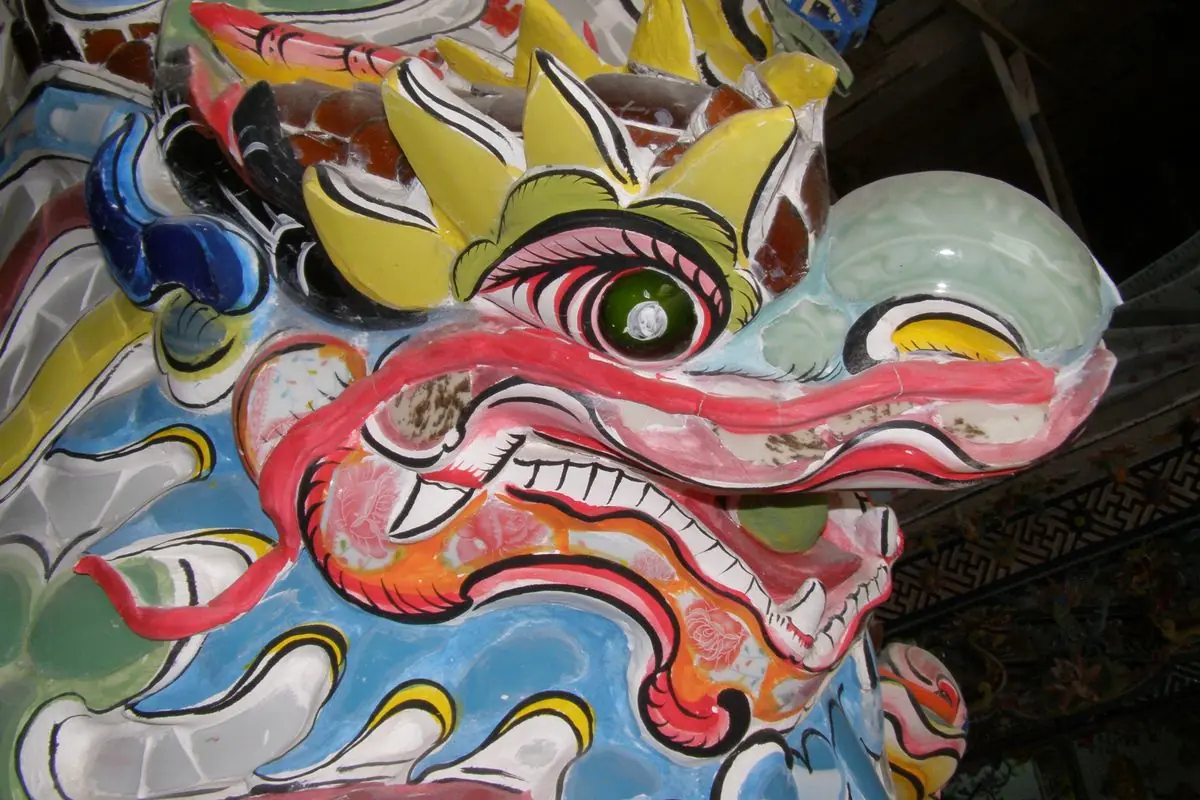
Begin in the front courtyard. Take in the rooflines, dragon-wrapped pillars and the way different buildings sit together. Then move closer to the mosaics. Small fragments of porcelain, glass and pottery have been set together to create large-scale decorative scenes.
The pagoda's origins date to 1949, with substantial development and renovation in later decades, particularly the 1990s. The complex you see today was not all finished in its current form when the first temple building was constructed. This explains the mix of highly elaborate newer structures and more traditional worship spaces.
Spend about ten minutes looking at the exterior as a whole. A wide photograph from a clear area of the courtyard will often tell more of the story than a close shot of a single shiny tile. Keep your distance from the decorations: ceramic edges can be rough, and climbing on a railing or leaning against a mosaic can damage it. Young children should not be allowed to run their hands along the dragon's body.
Follow the 49-meter dragon in Long Hoa Vien
Around 12,000 bottles
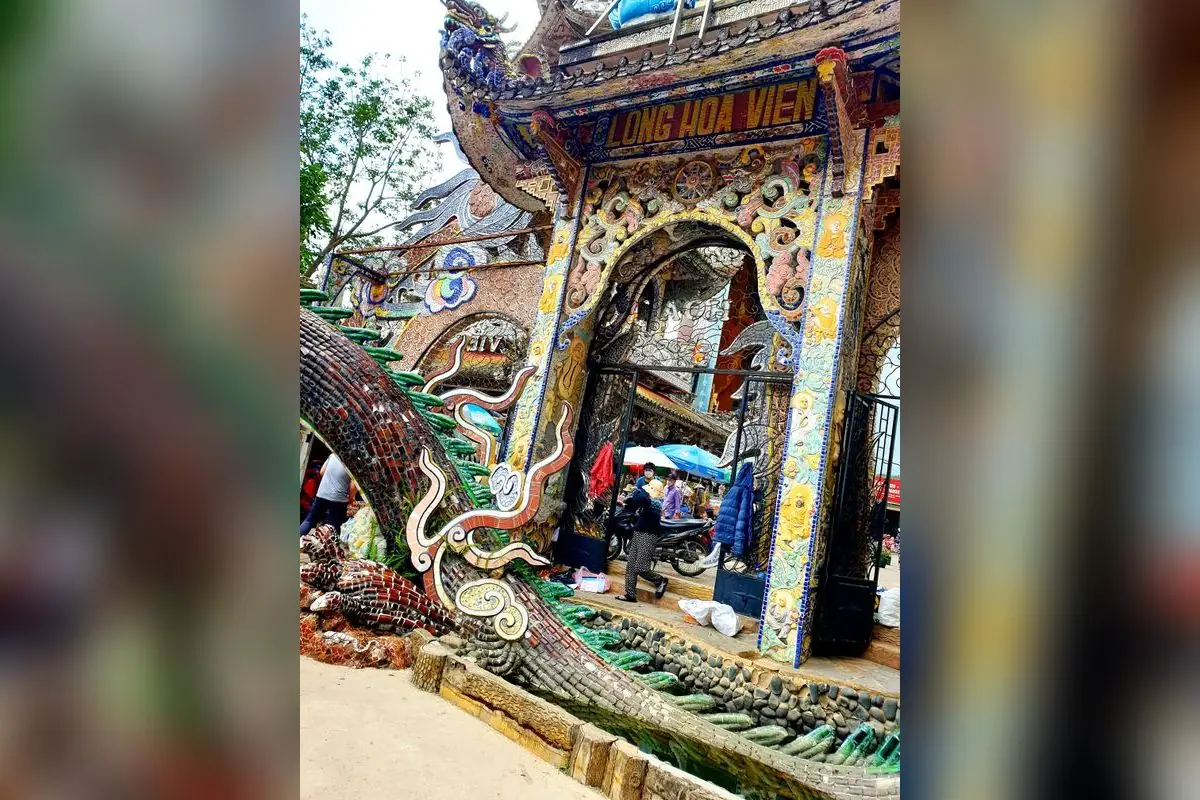
The Dragon Garden, or Long Hoa Vien, is the most recognizable part of the Bottle Pagoda. Its dragon is about 49 meters long, with an exterior decorated using around 12,000 bottles and other mosaic materials. It curves through the landscaped area near a figure of Maitreya Buddha. Walk through the permitted viewing spaces to take in its full length; from the entrance you only see the head.
Take a moment to compare two views. Close up, you can identify individual pieces of glass and pottery. A few steps back, those fragments become scales and larger shapes. The workmanship is a big part of the visit, even for travelers who know little about Buddhist art or Vietnamese religious architecture.
The garden is outdoors, which also makes it a reasonable place for a group photograph. Keep paths open for other visitors and do not sit on religious figures or climb the structures. A working temple is not a photography set, however colorful the backdrop may be.
Enter the main worship hall quietly
Shoes off, voices low
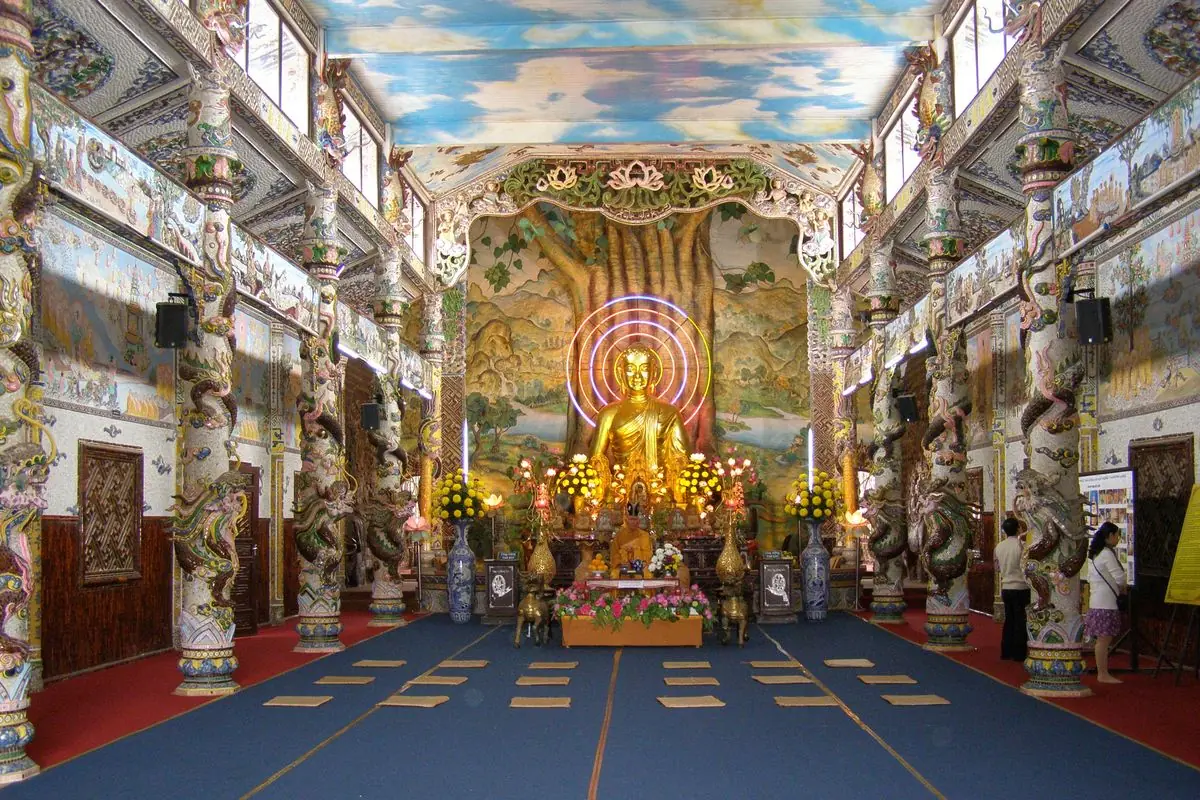
The main hall is where the pace should change. It contains a large seated Buddha figure, mosaic-covered pillars and other religious objects. Spend time observing from the visitor area. You can appreciate the architecture, and see that people come here to worship, without approaching the altar.
Look for signs about footwear before stepping inside. Remove your shoes where requested, place them neatly and avoid walking in front of someone who is bowing or praying. Keep your voice down. If a service is taking place, put the camera away and avoid crossing the space between worshippers and the altar.
A respectful non-Buddhist visitor can stand quietly, observe and leave without imitating a prayer ritual they do not understand. Those wishing to make an offering should follow local instructions. Donations are voluntary and are separate from admission, which is free.
See the seven-story bell tower
About 37 meters tall
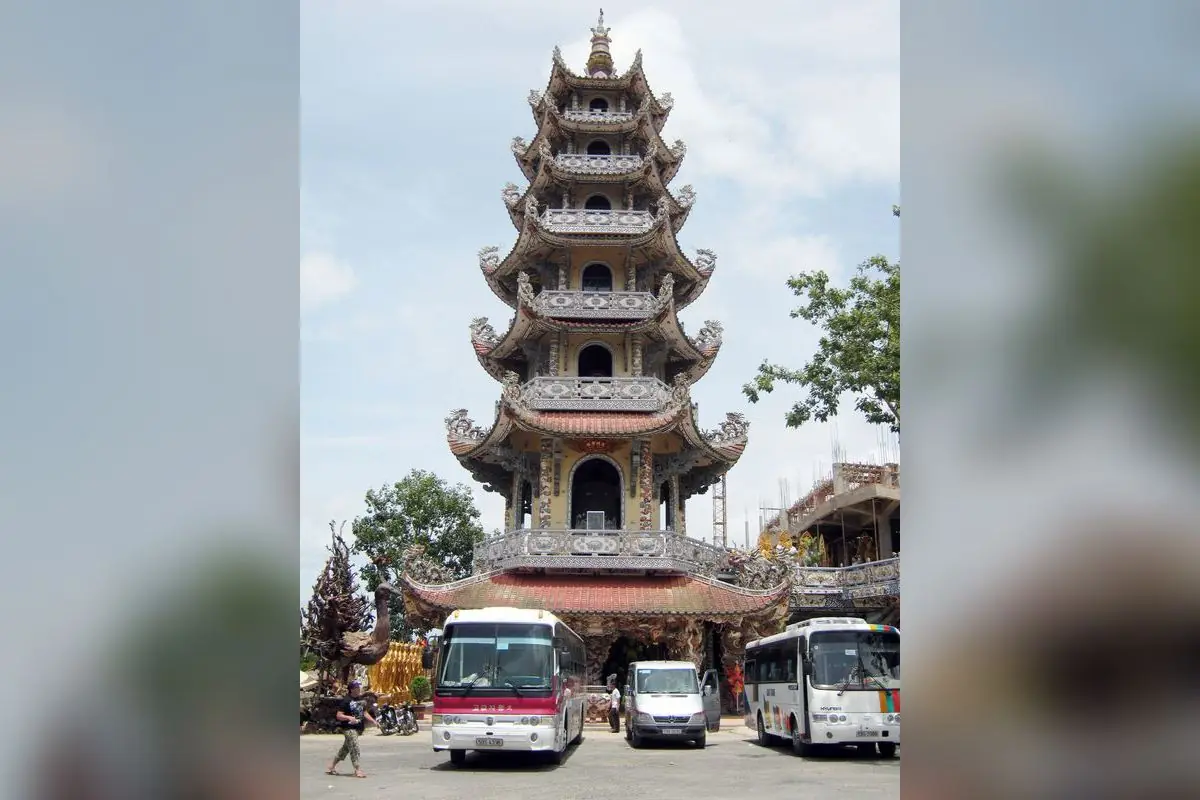
The bell tower rises to about 37 meters and has seven stories. Its large ceremonial bell, the Dai Hong Chung, is approximately 4.3 meters tall and weighs about 8.5 metric tons. The tower is covered with reliefs and ceramic patterns, including dragons and phoenixes, and makes an impressive contrast with the open Dragon Garden.
Start by looking up from the base, then enter only the sections currently open to visitors. Some parts of the climb can feel demanding, especially after a long day of sightseeing. If you have knee pain, limited stamina or young children in the group, the base and lower level are enough to appreciate the building. There is no requirement to reach the top.
The bell is a religious object. Do not ring it, pull anything attached to it or touch ceremonial equipment without permission. Notice the designs cast into its surface. A few minutes spent on those details can be more rewarding than racing up another flight of stairs.
What is worth seeing if you have another 30-60 minutes?
The Guanyin statue decorated with everlasting flowers
About 10-15 minutes
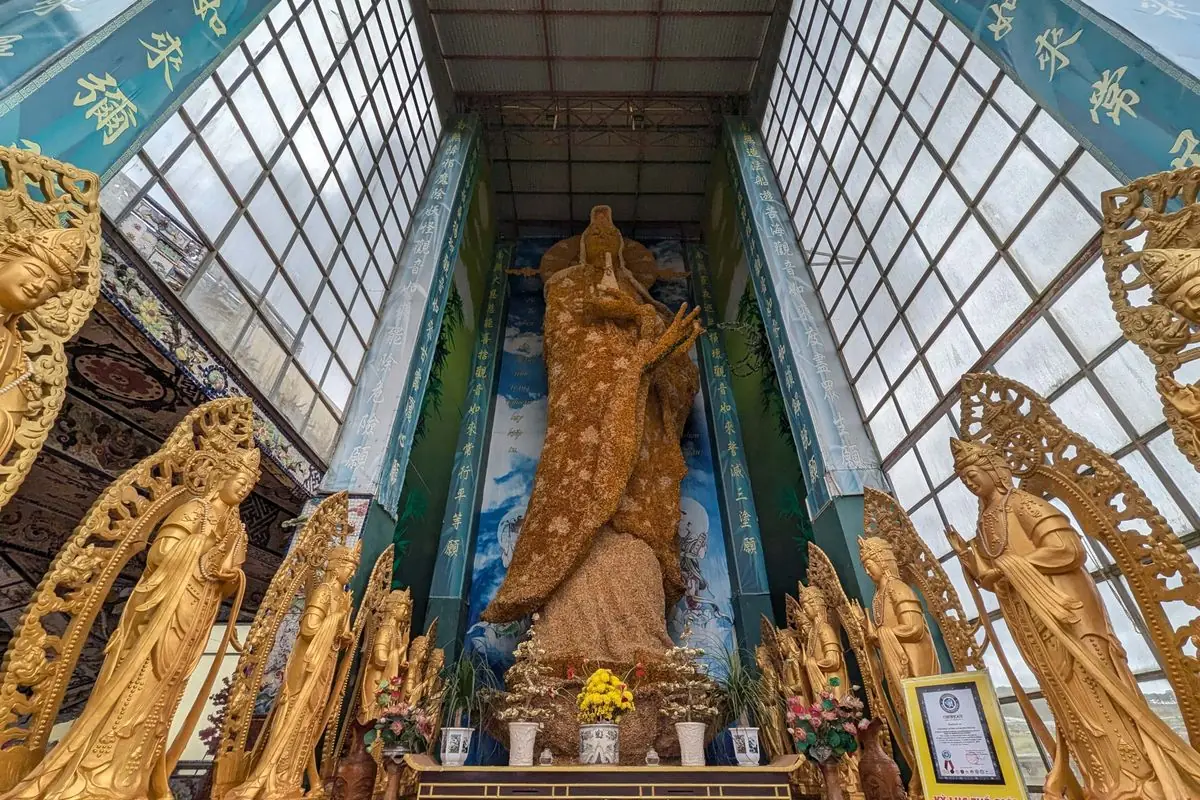
One of the more unusual sights is a figure of Guanyin, the Bodhisattva of Compassion, decorated with dried everlasting flowers. It looks very different from the glossy glass and ceramic mosaics in the courtyard. The flower surfaces give the figure a softer appearance, and maintaining the decoration requires care over time.
The statue is a devotional image. Stand in the visitor area, keep your hands off the flowers and make space for people who have come to pray. Set aside roughly ten to fifteen minutes if the area is open and accessible. Let people using the space for worship finish before you try for a clear photograph.
The exhibition known as the 18 levels of hell
An extra 20-30 minutes
The “18 levels of hell” is an exhibition route inside the temple complex. It uses scenes and figures to illustrate Buddhist and Vietnamese ideas about karma, consequences, compassion and filial duty, including the story of the disciple Maudgalyayana trying to help his mother. Some of the models depict punishment and suffering in a vivid, sometimes unsettling way.
Adults and older teenagers interested in the religious stories may find it worth the extra time. It is not an essential stop for young children, especially those disturbed by darkness or frightening figures. People who dislike enclosed or narrow spaces should skip it. The experience is very different from a relaxed walk around the bright, open courtyard.
Follow the marked path and keep moving when passages are narrow. Avoid stopping a group in the middle of a doorway. Flash photography and loud reactions can disturb others in an already crowded section. Allow an additional 20-30 minutes, depending on the number of visitors and which areas are open. Keep going to the marked exit; turning back against the flow blocks the passage for everyone.
Sculptures and display rooms
After the main highlights
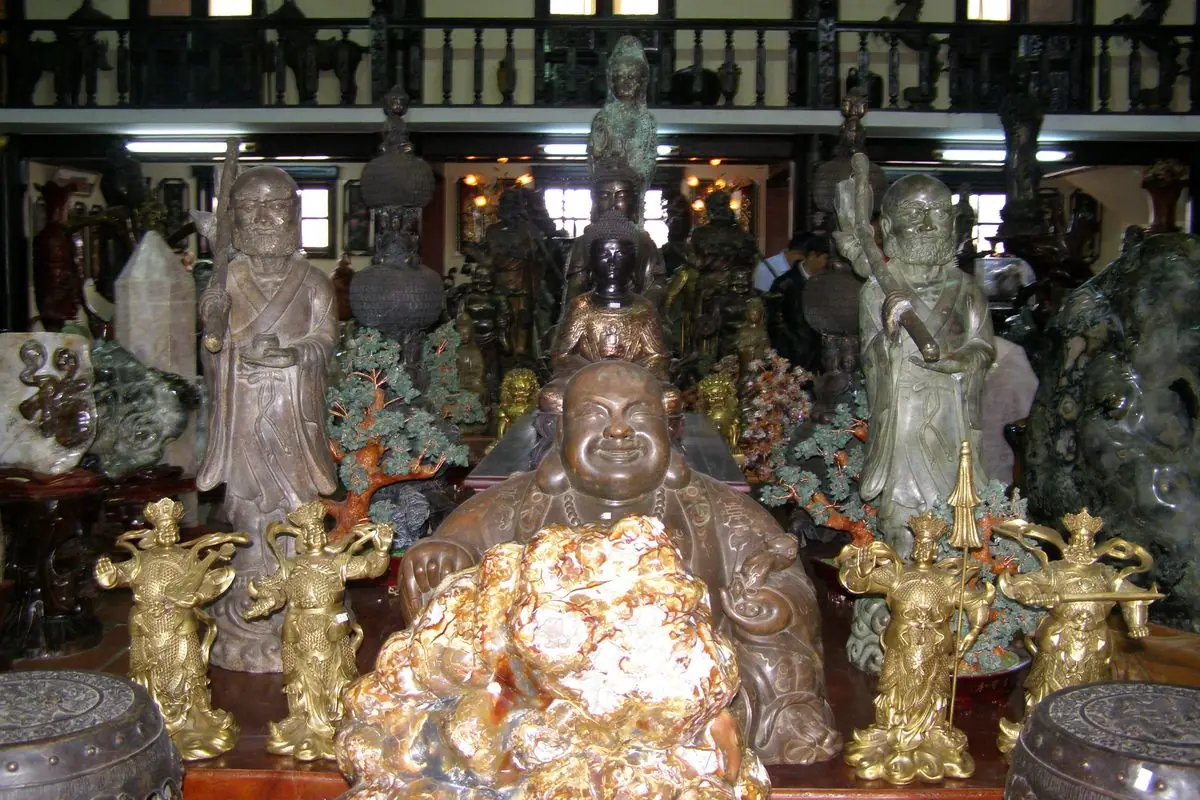
Other parts of the compound contain statues, carved woodwork and decorative objects. These displays are useful for people interested in sculpture and craft, but access can vary by room and by day. Check what is open after visiting the main highlights. Do not sacrifice the Dragon Garden or main hall because a side exhibition looked interesting on a map.
Some figures are wax sculptures that look remarkably lifelike. Read the label before deciding whether a seated figure is a monk physically present in the room. Do not touch an exhibit to test what it is made of. One clear photograph with its label, where photography is permitted, is more useful than several unexplained close-ups.
Linh Phuoc Pagoda dress code: what should you wear?
Comfortable flat shoes are a better choice than heels. The grounds include paving, steps and an underground display route. Surfaces can be damp even when it is not raining at the moment. A pair of clean socks is useful if you prefer not to be barefoot where shoes have to be left outside.
Hats, sunglasses and umbrellas are fine for the outdoor parts of the visit. Remove hats in worship halls, fold umbrellas and follow local signage. Ordinary modest clothes are enough, so there is no special religious clothing to buy at the gate. If you are traveling in a group, agree on suitable clothes beforehand so nobody has to sit outside while the others visit the main hall.
Clean, comfortable and relatively covered clothing will work for the pagoda and for a later cafe stop. The small effort also shows respect to the people who come here to worship.
Can you take photos inside Linh Phuoc Pagoda?
Photography is easiest in the courtyard and other exterior areas, but some spaces you are allowed to enter are still closed to photography. Follow any no-photography notice and instructions from temple staff. Prayer rooms and ceremonies deserve more care than outdoor architectural features.
For the mosaics, try one wide shot and one detail photograph. A wide composition explains the scale of the work; a closer frame shows how individual ceramic and bottle fragments fit together. Stand outside any protected area and change your angle for a better picture; never touch the work. On a bright day, reflective pieces can produce glare without the need for flash.
An open courtyard does not mean drones are allowed. Drone operations in Vietnam are subject to aviation rules and property restrictions, and a religious compound is not a place to launch one without explicit authorization. Large tripods, staged productions and commercial filming may also interfere with visitors or worshippers. Ask before arranging anything beyond ordinary handheld photography.
Visiting with children or older relatives
For young children, begin with the Dragon Garden and exterior mosaics. They are immediately interesting, require little explanation and do not demand a long stay in a prayer hall. Move to the hall for a short quiet visit, then consider the lower part of the bell tower. The underground hell exhibition may be frightening, so leaving it out is a sensible choice.
For older relatives, a 60-minute plan is often more enjoyable than a full two-hour circuit. You can see the main architecture without climbing every available stairway. Ask at the entrance which areas are reached by level paths and which require steps. Check before you go whether the temple is wheelchair-accessible and whether a lift serves the tower and basement. A car can take you to the site, but it cannot remove the stairs inside.
Mixed-age groups can split after the main hall. Visitors who want to climb the tower can go ahead while others rest in an appropriate area. Agree on a meeting point that does not block a doorway. A short rest and water break will often do more for everyone's enjoyment than adding one extra display simply because it is on a checklist.
This also matters for travelers on tight schedules. One person needing to stop for twenty minutes changes a carefully timed train connection. Keep the return journey flexible when mobility, children or changing weather are factors.
Combine Linh Phuoc Pagoda with Trai Mat and Xom Leo
Trai Mat is the neighborhood around the pagoda and railway station, with homes, roads, local shops and agricultural activity. It is not a separate attraction with an entrance ticket. After the pagoda, you can take a short look around the station area, find a local snack or continue to your next destination. Respect private homes, gardens and working greenhouses. Do not walk through someone's property for a photograph.
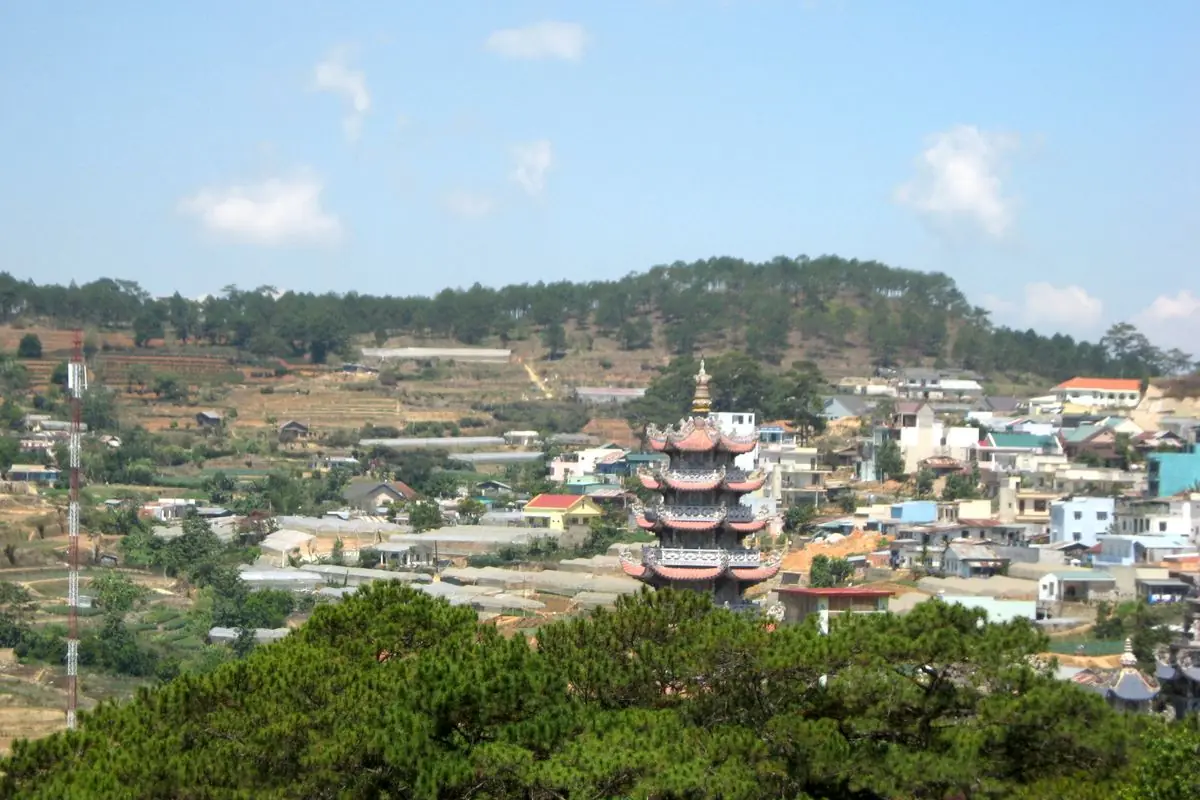
Xom Leo is an area around Huynh Tan Phat Street where hillside cafes and restaurants look over the valley and greenhouse roofs. It is known for late-afternoon light and for the illuminated greenhouses after dark. Xom Leo is not one centrally managed theme park. Public roads, private viewing spots and individual businesses have different rules. Check a venue's menu, seating policy and opening time before ordering; drink prices vary from one place to the next.

The combination works because the purposes of the two stops are different. At the pagoda you need daylight, quiet behavior and enough time to explore. At Xom Leo you are primarily choosing a view, a seat and a time of day. Treating both as photo stops to be visited in any order usually leaves you at one of them at the wrong time.
Plan A: a straightforward morning visit
| Suggested time | Plan |
|---|---|
| 7:30 am | Leave central Da Lat by motorbike or car |
| 8:00 am | See the facade and Dragon Garden |
| 8:20 am | Visit the prayer hall and the bell tower's lower area |
| 8:50 am | See the flower-decorated Guanyin or one other open display |
| 9:15 am | Leave the temple and look around Trai Mat |
| 10:00 am | Return to town or continue elsewhere |
This plan suits travelers short on time, families and anyone who prefers the calmer morning hours. It leaves the afternoon free without forcing an additional trip to the hillside. Visiting Xom Leo early in the morning makes little sense when the main reason to go is the sunset and evening greenhouse lights; save it for another afternoon.
Plan B: the pagoda followed by Xom Leo at sunset
| Suggested time | Plan |
|---|---|
| 1:15 pm | Leave central Da Lat |
| 1:45 pm | Enter Linh Phuoc Pagoda; start with the garden and hall |
| 2:30 pm | See the bell tower, Guanyin or underground display |
| 3:15 pm | Leave the pagoda and make a short Trai Mat stop |
| 3:45-4:00 pm | Reach Xom Leo and choose a suitable viewpoint or cafe |
| 4:00-6:00 pm | Enjoy the late light and views across the greenhouses |
| Afterwards | Have dinner or return to town using prearranged transport |
Couples and friends who want both architecture and a late-afternoon view will like this plan best. It avoids arriving at the temple as its visiting hours end. You also reach Xom Leo early enough to choose a seat while there is still daylight. Cloud and mist may cover the valley, so keep the second half of the outing flexible; a clear sunset is never a sure thing.
Bring a jacket for the later stop. The temperature can feel noticeably cooler once you have been sitting outside for a while. Check the hours and reservation policy of any restaurant you plan to eat at. The general afternoon viewing window does not tell you when every kitchen serves dinner.
Entrance fees, transport costs and a final checklist
Linh Phuoc Pagoda is free to enter in 2026. There is no admission ticket to purchase for the main open visitor areas. You may still spend money on transport, locally managed parking, food and drinks, or a separate venue in Xom Leo. Offerings and donations are optional; they are not an admission charge.
The Da Lat-Trai Mat train ticket is separate from the pagoda. Railway fares vary by service, seat and passenger eligibility, so use the Vietnam Railways booking information or its sales partners for your actual date. The same principle applies to a taxi: confirm the amount with the operator before traveling. A previous visitor's fare is not an exact quote for your journey.
Before leaving the hotel, check that your shoulders and knees will be covered, your footwear is suitable for stairs and your phone has enough battery for navigation. Keep at least an hour free at the temple, and more if you want the underground route. Check the train return time if you are arriving by rail. If you intend to stay in Xom Leo after sunset, bring a warmer layer and make a realistic plan for getting back to town.
Finally, decide what you actually want from the visit. Someone interested in the main hall and religious atmosphere does not need to cover the full compound. Someone keen on the craftwork should not spend their entire visit taking photographs of the first gate. Give the visit a clear purpose and the pagoda is an easy stop to enjoy.
Choose your visit
For a quiet temple stop, go in the morning and spend an hour on the Dragon Garden, main hall and lower bell-tower area. An architecture-focused visit plus Xom Leo works best if you arrive in early afternoon, stay up to two hours and travel onward by road; if the train is part of the plan, sort out your return journey before entering the pagoda.
FAQ
What is the Linh Phuoc Pagoda entrance fee?
Entry is free. This covers normal access to the visitor areas open that day. Transport, possible parking charges, food, drinks and purchases at other businesses are separate. You are not required to make a donation or buy an offering to enter.
What are Linh Phuoc Pagoda opening hours?
The pagoda is open to visitors from 7:00 am to 5:00 pm daily. Individual rooms may close or restrict entry during religious events or maintenance. Arrive before 4:00 pm if you want time for the bell tower and additional exhibits.
What is the Linh Phuoc Pagoda dress code?
Wear clothes that cover your shoulders and knees. Long trousers, below-knee skirts and comfortable shoes are practical. Remove shoes and hats wherever required in a worship hall, and follow signs about photography and religious services.
How long does it take to visit Linh Phuoc Pagoda?
Allow about 60 minutes for the Dragon Garden, main hall and bell tower's lower area. A more complete visit with the flower-decorated statue and underground exhibition takes around 90-120 minutes. The tourist train's short turnaround is not enough for the longer route.
Can I combine Linh Phuoc Pagoda with Xom Leo?
Yes. Start at the pagoda around 1:30-2:00 pm, leave before 4:00 pm, then head to the Huynh Tan Phat area for late-afternoon valley views. A car or motorbike makes the combination more flexible than relying on a short train connection.